
{title}
{publish}
{head}

Mornings in Long Coc — the “Ha Long Bay on land” — as kitchen smoke still lingers over stilt house roofs, are the moments when locals prepare to welcome their first guests of the day. A meal featuring local dishes, stories of traditional crafts, folk songs, and dances... these elements, once so ordinary in daily community life, have now become the experiences tourists actively seek.
Leveraging the inherent values of landscape, culture, and people, community-based tourism (CBT) is opening new development directions across many localities in Phu Tho Province. Yet, for a land with potential to become an attractive destination capable of retaining visitors, a long journey lies ahead, in which the quality of products, services, human resources, and promotional methods play a decisive role.
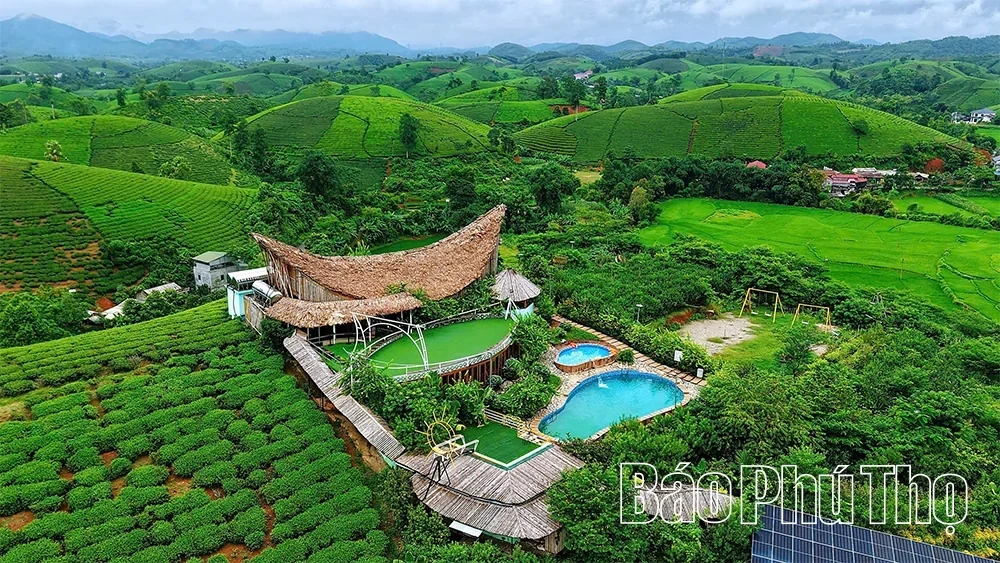
Long Coc — an attractive destination with its characteristic tea hill landscape and strong potential for community-based tourism development.
Awakening Local Values
Blessed by nature, Long Coc stands out with its rolling, overturned-bowl-shaped tea hills, creating a lush green complex typical of the midland region. This scenery attracts not only nature lovers and photographers but is increasingly appealing to tourists seeking experiences close to rural life.
The charm of Long Coc also stems from the cultural identity of the Muong and Dao ethnic groups, with traditions, festivals, and dances preserved through generations. Exploiting these advantages, the locality has identified tourism — particularly CBT — as a pathway to generate additional livelihoods for residents. Mr. Nguyen Xuan Viet, Chairman of the Long Coc Commune People’s Committee, stated: “The commune has issued and implemented a project to foster internal strength, boost investment attraction, and develop the economy linked with green tourism for the 2026–2030 period, with a vision toward 2045.” Along with infrastructure investment, the locality is focusing on diversifying and upgrading product quality, building multi-value circular agricultural models to serve tourism, preserving cultural values, and enhancing dining and accommodation services.
The Long Coc story demonstrates the untapped potential for CBT in Phu Tho. Following the administrative unit restructuring, the province’s tourism space has become even more diverse, converging various terrains, landscapes, and ecosystems. From the ancestral cultural space and cool midland regions with tea hills and hot springs to Xuan Son National Park, the Da River reservoir area, and high-altitude ethnic villages... every area can form unique tourism products.
If landscape is the “backdrop,” culture is the element that defines the identity of CBT. The Worship of Hung Kings, Xoan singing, and a vast system of festivals, customs, cuisine, and folk arts are exceptional resources. With approximately 1,000 traditional festivals, Phu Tho has the conditions to develop products linked to cultural experiences that are seasonal, regional, and community-specific.
A greater advantage lies in the ability to connect these values into a journey. Tourists can start from the Ancestral Land cultural space, continue with agricultural experiences, explore nature, savor local cuisine, learn about traditional crafts, and stay overnight in village homestays. When individual resources are connected into a chain of experiences, not only is the duration of stay extended, but many stakeholders within the community also have the opportunity to share in the benefits.
Elevating Quality for the Long Term
The gap between having an advantage and having an attractive destination is significant. Therefore, alongside exploiting potential, localities are shifting from a mindset of “exploiting whatever is available” to building products that possess narratives, experiences, and distinct identities.
A key focus is linking CBT with agriculture, OCOP (One Commune One Product) products, craft villages, and indigenous culture. Localities are mobilizing resources to invest in infrastructure, auxiliary facilities, and product showrooms; simultaneously upgrading power, water, telecommunications, and transport systems to ensure security, safety, and service conditions for visitors.
To date, the entire province has 4 OCOP products in the tourism services group, 3 of which have achieved a 3-star rating: Hung Lo CBT, Xuan Son CBT, and Da Bia CBT; and 1 product, Mo Hamlet CBT in Thung Nai Commune, has achieved a 4-star OCOP rating.
In Mo Hamlet, CBT development has gradually brought about changes in daily life. According to Mr. Dinh Van Dan, Head of the Mo Hamlet CBT Cooperative Group, alongside investing in transport infrastructure, parking lots, and bridges, the locality emphasizes building ethnic performance teams and providing skills training for residents. Tourism not only creates extra income but also raises community awareness of cultural preservation and environmental protection. In 2025, the per capita income in the hamlet reached over VND 41 million; the hamlet now has only 4 poor households and 2 near-poor households.
Another factor creating clear momentum is the way destinations are promoted. Rather than relying solely on traditional promotion, many localities proactively exploit digital platforms to bring images of their homeland closer to tourists. In Van Son, Commune Party Committee Secretary Nguyen Duy Tu personally produces videos introducing the local landscape, culture, and people. As of July 2026, nearly 20 videos have been posted on social media platforms, with each attracting thousands to millions of views. The impact of social media has quickly generated tourist interest. Many seek information about Van Son, asking about travel routes and experiences. On weekends, spots like Thung Waterfall and Pang Field are frequently crowded. According to Van Son Party Secretary Nguyen Duy Tu, the commune has an average altitude of 800–1,200m above sea level, a cool climate, and a system of primary forests, waterfalls, caves, and Muong villages that retain many traditional cultural features. The locality is orienting Van Son to become a provincial-level tourism hub, developing eco-tourism and resorts, and striving to add approximately 20 homestays each year, step-by-step forming a community accommodation system to meet tourist needs.
From Long Coc to Van Son, from Xuan Son to the Da River reservoir area, different approaches are all aiming for the same goal: turning advantages into products, products into livelihoods, and making the community the true subject of tourism.
In the coming time, localities will continue to strengthen linkages between OCOP products and destinations; build experiential tours linked to specialty production zones, craft villages, and native products; improve the quality of accommodation; train human resources; and accelerate promotion through digital technology. Ultimately, the appeal of CBT lies not just in scenic beauty. It also lies in the story behind a roof, the flavor of a dish, the singing of the people, and how the community preserves what belongs to them.
Ensuring that every destination has its own product, every product has a story, and residents truly benefit from the values they are preserving — that is the path for Phu Tho’s community-based tourism to move from potential to sustainable development.
Le Oanh

baophutho.vn On the afternoon of August 12, Mr. Vu Viet Van — Standing Committee Member of the Provincial Party Committee and Vice Chairman of the...

baophutho.vn Morning in Long Coc — the “Ha Long Bay on land” — as stove smoke still lingers over the stilt house roofs, is also when local residents prepare...

The legeacy of resistance literature and arts in the ancestral land

baophutho.vn Blessed with the picturesque Ho Ly Lake, sprawling cinnamon forests, and the rich cultural heritage of the Dao and Muong ethnic groups, Thuong...

baophutho.vn Behind every dish lies a story of the land and its people. From a rich, savory cup of midland green tea, Thanh Son sour pork, and traditional...

baophutho.vn Often likened to a "Ha Long Bay on the mountains," Hoa Binh Lake possesses immense potential to become a key national tourism area. By blending...

baophutho.vn Nestled on Ngoc Phac Mountain along the right bank of the Red River, Phuc Thanh Pagoda (Village 2, Tam Nong Commune) has long been a familiar...

Fish cooked with wild sour bamboo shoots – Authentic flavors, rich in tradition

baophutho.vn Amidst the endless waves of the Hoa Binh Reservoir, the Da Bia community-based tourism village (Duc Phong hamlet, Tien Phong commune) emerges...

baophutho.vn Still the familiar bowl-shaped green tea hills compared to an inland Ha Long Bay, Long Coc today is no longer just a place to stop, breathe,...
Editor-in-chief: Vi Manh Hung
License No.154/GP-BTTTT dated March 3,2022 by the Ministry of Information and Communications.
Address : No.Nguyen Tat Thanh street, Viet Tri ward, Phu Tho province
Tel: (0210) 3846.508; (0210) 3855.303
Email: info@baophutho.vn
Website: baophutho.vn
Copyrights Phu Tho Newspaper; All rights reserved
