
{title}
{publish}
{head}

Identifying tourism as an economic sector with high spillover potential, Phu Tho province is concentrating on mobilizing resources to invest in infrastructure towards a synchronized and modern direction. The gradual completion of infrastructure not only enhances destination quality but also expands development space, creating investment attraction and elevating value generated from tourism.
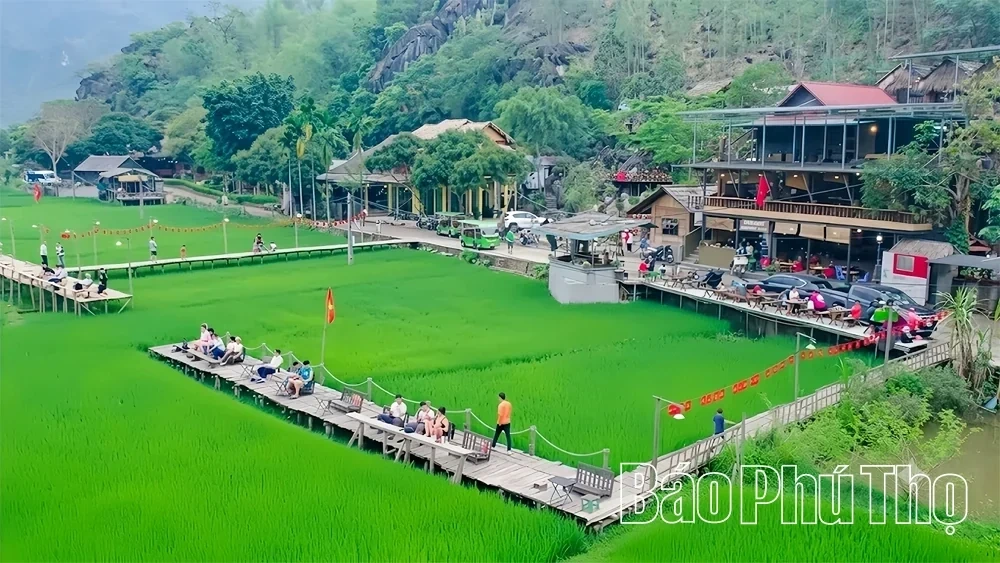
Lac Village, Mai Chau commune gradually completing infrastructure to develop community-based tourism.
With its position connecting Hanoi Capital, the Northern midlands and mountainous regions, and the Northwest alongside road, rail, and waterway transport systems, Phu Tho possesses numerous advantages in forming inter-regional tourism corridors. Over recent years, the province has focused on infrastructure investment across key tourism areas and spots, step-by-step establishing accommodation, service, resort, and entertainment systems.
The entire province currently hosts 1,520 accommodation establishments with over 20,000 rooms and 182 hotels, including 9 hotels meeting 4-5 star standards alongside 94 travel enterprises. During the 2020–2025 period, state budget funding allocated to tourism development was estimated at over 129 billion VND. |
Alongside state resources, numerous large-scale projects have been attracted, contributing to creating a fresh outlook for destinations. In Tam Dao, Dai Lai, Thanh Thuy, Thanh Lanh, and Van Lang..., resorts, golf courses, and eco-urban areas are taking shape, supplementing high-quality tourism products.
The province is focusing on upgrading Tam Dao National Tourist Area; while step-by-step fulfilling national tourist area criteria for Dai Lai - Ngoc Thanh, Tay Thien - Tam Dao II, and surrounding vicinities. Several prominent projects have entered operation, including Flamingo Dai Lai with a registered capital of 4,630.46 billion VND, Tay Thien Cable Car with an investment of 245 billion VND, alongside a series of projects by Lac Hong Investment JSC in Tam Dao I...
Road transport expansion—including connecting routes such as Long Coc tea hills - Xuan Son National Park, Tan Phu - Xuan Dai; routes connecting the Noi Bai – Lao Cai Expressway with Hung Temple, Ao Chau Pond, and Au Co Mother Temple; Van Lang Bridge, Vinh Phu Bridge, and the Tuyen Quang – Phu Tho Expressway...—has gradually shortened travel times and boosted connectivity between destinations.
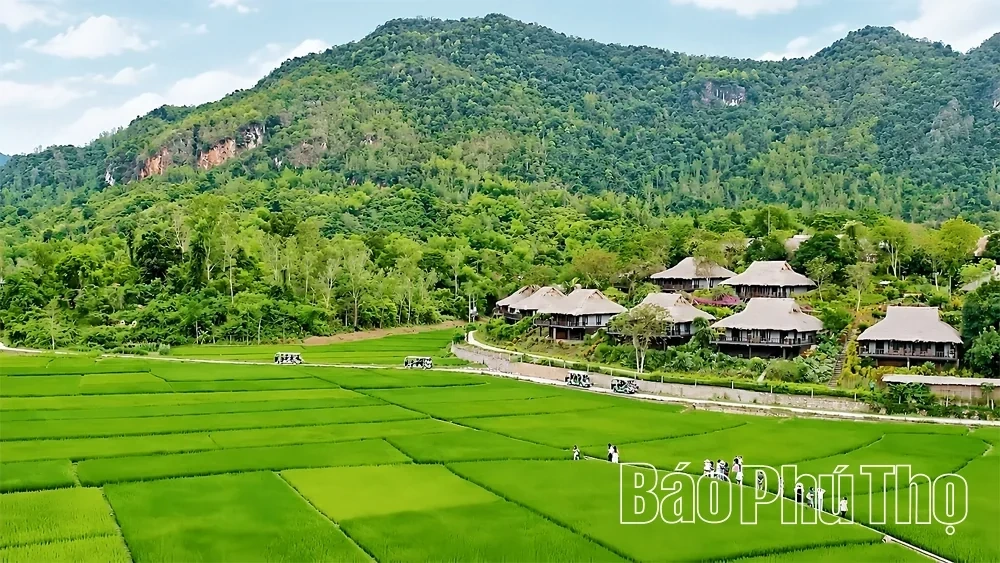
Multiple tourism products and services have been integrated, contributing to elevating visitor service quality.
On that foundation, the province is step-by-step shaping tourism spaces according to regional advantages: Viet Tri serves as the origin cultural tourism center; Thanh Thuy develops hot spring resort tourism; Xuan Son develops eco-tourism; Ha Hoa develops cultural and eco-tourism; while Tam Nong develops eco-urban, resort, and sports tourism. Moving from isolated destinations, products are being linked into chains, creating appeal and mutual complementarity.
In the Hoa Binh Lake area, investments in transport infrastructure, piers, parking lots, rest stops, and waterways are creating favorable conditions to effectively exploit eco-tourism, resort, and community tourism potential. Provincial Road 435 spanning 24.8 km was upgraded with a total investment of 756 billion VND, alongside numerous works connecting community tourism villages, historical sites, and scenic spots, laying the groundwork for continuous tour routes.
The area’s appeal is further demonstrated through 49 tourism projects with total registered capital exceeding 21,460 billion VND during the 2020–2025 period.
In Mai Chau, developing eco-tourism tied to ethnic cultural preservation is identified as a strategic breakthrough. According to Comrade Ha Trung Thao — Chairman of the Mai Chau Commune People’s Committee, for the 2025–2030 tenure, the commune identifies eco-tourism development linked with preserving ethnic cultural values as a strategic breakthrough—aiming by 2030 to build Mai Chau into a national-level eco-tourism area.
The locality is focusing on constructing core community tourism zones, improving access roads to upland villages, elevating service quality, accelerating digital transformation, and connecting households with travel firms. Among these, the 118-hectare Noong Luong Retreat project with a total capital of 359 billion VND has contributed to expanding resort spaces and connecting high-tech agriculture with tourism services.
Movements in infrastructure and investment are generating clear effects on tourism growth. Over the first 9 months of 2026, Phu Tho welcomed approximately 13.4 million tourists, an increase of 10.29% year-on-year; including around 460,000 international visitors. Tourism revenue reached nearly 13,700 billion VND, up 11.02%.
However, new development requirements also pose issues that require continued resolution. Resolution No. 29-NQ/TU dated June 5, 2026, on Phu Tho tourism development for the 2026–2030 period highlights several limitations regarding connecting transport, parking lots, rest stops, signage, as well as power, water, and telecommunications infrastructure; alongside a shortage of high-end accommodation facilities, entertainment services, and distinct tourism products.
In the coming time, the province will continue prioritizing infrastructure investment in key driver areas, national tourist zones, and potential destinations; upgrading infrastructure at Hung Temple, Tam Dao, and Hoa Binh Lake; while perfecting inter-regional transport, boat piers, parking lots, rest stops, and essential visitor facilities. Concurrently, efforts will accelerate destination digitization, constructing data repositories and smart tourism ecosystems.
Phu Tho also aims to form a continuous tourism space along the Tam Dao – Viet Tri – Thanh Thuy – Xuan Son – Hoa Binh Lake – Mai Chau axis, enhancing connectivity with Noi Bai International Airport and regional transport networks.
Alongside public investment, the province is stepping up socialization, attracting strategic investors to develop high-end resorts, 4-5 star hotels, entertainment venues, creative cultural spaces, walking streets, food streets, and the night economy.
Prioritizing infrastructure development creates the foundation for provincial tourism to shift from quantitative growth to qualitative elevation. This serves as the basis for the province to step-by-step build a high-quality, highly competitive tourism ecosystem—aiming to become a national cultural-festival tourism center and a prominent destination for belief culture, ecology, and resorts in Northern Vietnam by 2030.
Le Oanh

baophutho.vn Resolution No. 29-NQ/TU dated June 5, 2026, issued by the Standing Committee of the Provincial Party Committee on the development of Phu Tho...

baophutho.vn On the morning of September 29, Comrade Tran Duy Dong — Alternate Member of the Party Central Committee, Deputy Secretary of the Provincial...

baophutho.vn Beyond being local goods tied to community life and culture, many specialties of Phu Tho are being standardized, branded, and integrated into...

Phu Tho co communal house

baophutho.vn Phu Tho's tourism space after the merger expands broadly from Hung Temple, Tay Thien, and Tam Dao to Long Coc, Thanh Thuy, Xuan Son, Hoa Binh...

baophutho.vn Traditional markets adapt to modern life

baophutho.vn Tucked away in a valley of the Northwest region, Lac Village in Mai Ha commune offers a peaceful scenery and a culture steeped in identity....

baophutho.vn Tho Tang - The land of heritage

baophutho.vn Far from being an expensive delicacy, Dam Vac small freshwater fish is still proudly spoken of by locals as a signature specialty of the former...

baophutho.vn Phu Tho is actively integrating OCOP (One Commune One Product) items into tourism development, gradually transforming local specialties, craft...
Editor-in-chief: Vi Manh Hung
License No.154/GP-BTTTT dated March 3,2022 by the Ministry of Information and Communications.
Address : No.Nguyen Tat Thanh street, Viet Tri ward, Phu Tho province
Tel: (0210) 3846.508; (0210) 3855.303
Email: info@baophutho.vn
Website: baophutho.vn
Copyrights Phu Tho Newspaper; All rights reserved
