
{title}
{publish}
{head}

Amidst a myriad of rustic local delicacies like sticky rice cake with molasses, sweet mung bean paste, and pork sausage, Ngoa cake from the ancient village of Lung Ngoai (Vinh Thanh commune) retains a truly special place. Far beyond a simple rustic treat, each cake represents a piece of cultural heritage, encapsulating the warm hospitality and spirit of the people of the Ancestral Land.
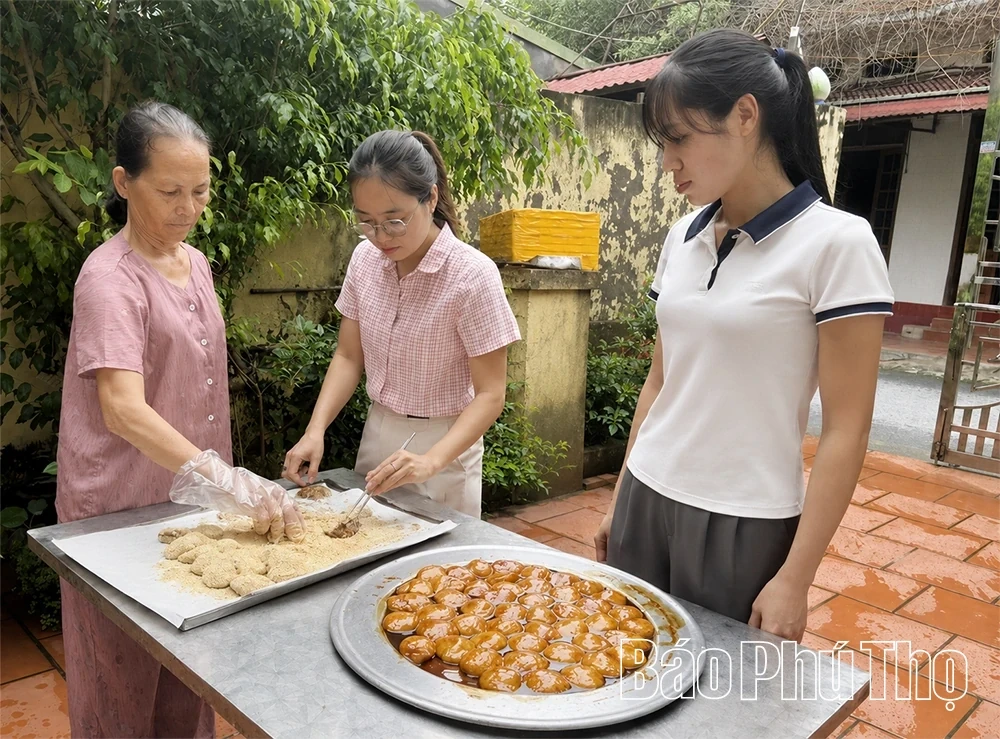
Tourists enthusiastically experience the steps of making banh Ngoa when visiting the ancient village of Lung Ngoai.
According to village elders, that uniqueness stems from a long history closely linked to solemn rituals. In the past, Ngoa cake was considered a delicacy, made only on special occasions such as festivals, Lunar New Year, village feasts, or milestone birthday celebrations. On such celebration days, the host family had to prepare up to around 10 kg of cakes, skillfully stacking them into a truncated cone shape on a bronze tray before solemnly processing them to the communal house to honor the deity.
To prepare such a painstaking tray of cakes, the entire family and clan would gather—some washing the rice, others sifting the mung beans—creating a tight-knit and warm village atmosphere. Today, Ngoa cake has become popular in daily life, serving as a cherished gift for locals to welcome honored guests or send to friends from afar.
Although it has become a familiar gift, the name Ngoa cake still sounds quite unfamiliar to visitors from other regions. Few would guess that its ingredients are deeply tied to farming life: fragrant glutinous rice, mung beans, and sugarcane molasses. Simple as the ingredients may be, producing a batch with the authentic taste requires strict standards right from ingredient selection, along with the skillful hands of the baker.
The rice used for the cake must be round, plump, and fragrant glutinous rice, which is washed clean, drained, and ground into a powder as fine as silk. The mung beans are sorted to remove flat seeds, soaked until plump, and peeled clean. A portion of the mung beans is cooked with sugarcane molasses and stirred constantly over a fire until it thickens into a pliable layer of che kho to serve as the filling. The remaining mung beans are toasted in a pan until highly aromatic, then finely ground into a layer of bean powder to coat the exterior.
Once the preparation is complete, the artisan kneads the glutinous rice flour with water, shaping it into flat, round wrapper portions that enclose the molasses sweet bean filling inside before dropping them into a pot of boiling water. Waiting until the cakes are cooked and naturally float to the surface, the artisan scoops them out and quickly rolls them in the golden mung bean powder coating.
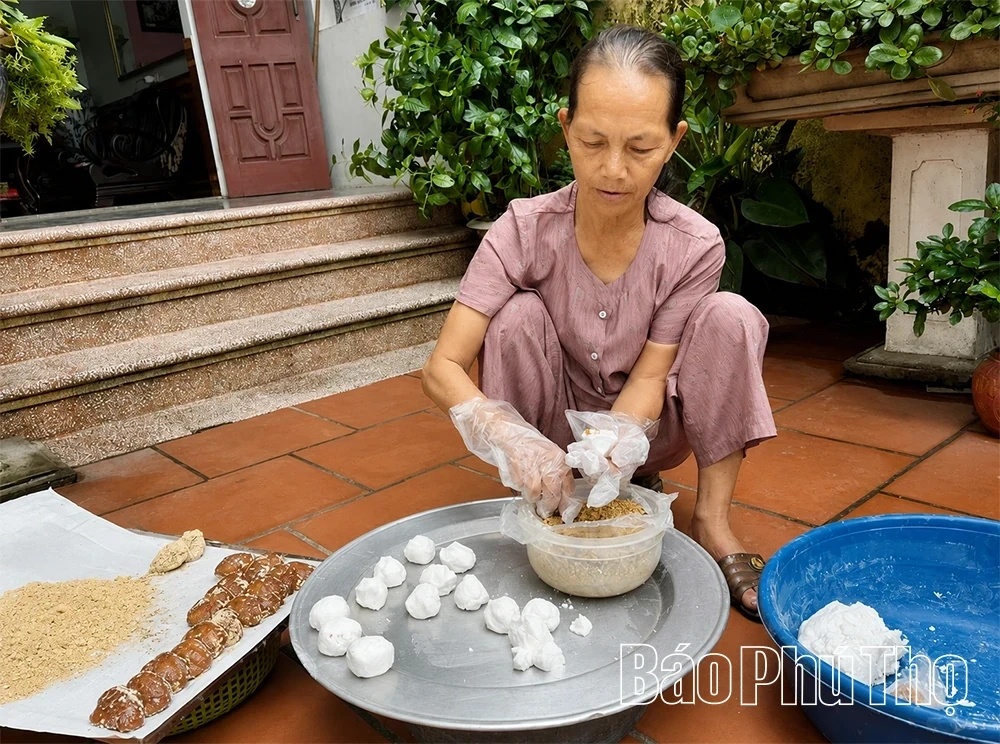
Mrs. Le Thi Lun, one of the few locals in the ancient village of Lung Ngoai who remains dedicated to the craft of making Ngoa cake.
Mrs. Le Thi Lun, one of the few local residents still attached to the craft of making Ngoa cake, shared: “Making Ngoa cake looks easy, but making the cake chewy without being sticky, and sweet without being cloying, is a true art. The kneading and boiling stages are the most critical. The boiling fire must be steady; as soon as the cakes float, they must be taken out immediately, as leaving them too long will make them soggy. Rolling them through the mung bean flour must be done while the cakes are piping hot so the powder clings tightly to the crust. This trade is laborious and demands patience, but just thinking about preserving the flavor passed down by our ancestors and hearing customers praise it as delicious makes all the tiredness disappear.”
From those skillful hands, Ngoa cake emerges with a deeply elegant appearance. Perfectly round and clad in a soft, fine powder layer, it exhales the gentle aroma of glutinous rice and mung beans. Taking a bite, diners immediately feel the smooth chewiness of the sticky rice crust blending with the rich, nutty, and mildly sweet flavor of the sugarcane molasses filling. The outer mung bean powder layer not only prevents the cakes from sticking together but also releases a touch of natural essential oil, creating a rich taste where the sweet aftertaste deepens the more it is chewed.
Through the passage of time, Ngoa cake retains the pristine rustic and refined qualities of its origins. This dish not only enriches the regional culinary map but also serves as a bridge of memories, reminding future generations of a warm and simple traditional cultural beauty. If you ever have the chance to visit the ancient village of Lung Ngoai, do not forget to look for these traditional chewy, fragrant Ngoa cakes to savor their elegant flavor and pick some up as gifts for friends and loved ones.
Tran Tinh

baophutho.vn The craft of driftwood sculpting in Doan Ket hamlet, Luong Son commune is not merely a livelihood, but a journey of preserving the original...

baophutho.vn Tro Temple

baophutho.vn Phu Tho Culture Express - Traditional markets adapt to modern life

baophutho.vn Preserving Muong brocade

baophutho.vn Phu Tho Cultural Express - When architecture tells historical stories

baophutho.vn In the process of nation-building and defense, the Vietnamese people throughout history have always turned toward the Hung Kings — who not only...

baophutho.vn On the afternoon of September 7, the Provincial People's Committee held a conference to hear reports from units regarding preparation progress...

baophutho.vn Not only meeting the spiritual cultural needs of the people, the work of preserving and promoting ethnic cultural identity in Muong Thang...

baophutho.vn Phu Tho Cultural Express - Preserving the cultural heritage of the Dao people

baophutho.vn Once facing the risk of fading away, the Dong Lai brocade weaving craft, now in Doan Ket Village, Tan Lac Commune, is gradually "reviving"...
Editor-in-chief: Vi Manh Hung
License No.154/GP-BTTTT dated March 3,2022 by the Ministry of Information and Communications.
Address : No.Nguyen Tat Thanh street, Viet Tri ward, Phu Tho province
Tel: (0210) 3846.508; (0210) 3855.303
Email: info@baophutho.vn
Website: baophutho.vn
Copyrights Phu Tho Newspaper; All rights reserved
