
{title}
{publish}
{head}

With a strategic cultural vision, shortly after national independence, President Ho Chi Minh signed Decree No. 65/SL on November 23, 1945, regarding the protection of tangible heritage. He declared: "Conserve antiquities throughout the entire territory of Vietnam." Deeply embedding his teachings, Phu Tho province—the sacred Ancestral Land—has tirelessly strived to preserve and promote its cultural heritage values.
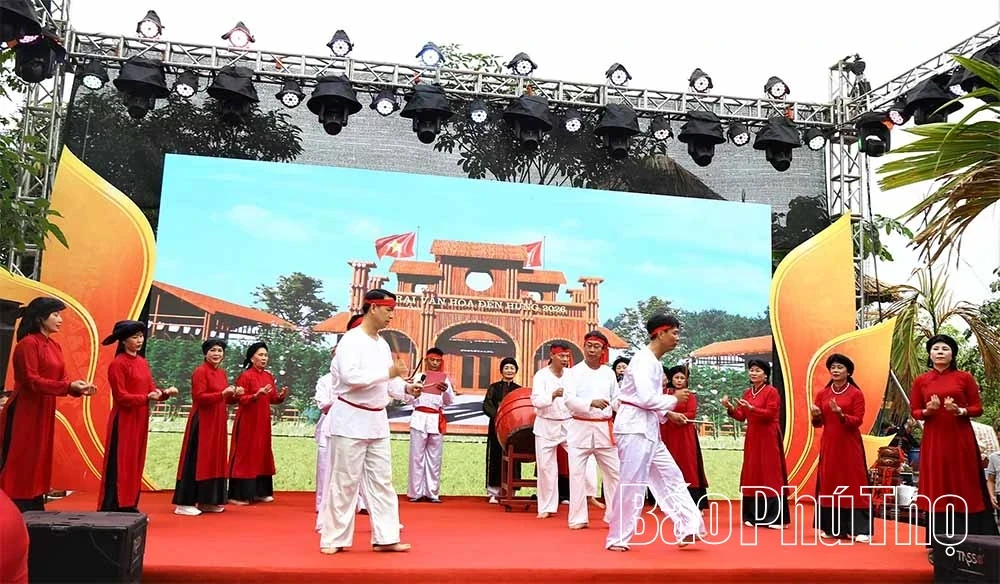
Phu Tho Xoan Singing performance – spreading the values of the heritage to local people and tourists, both domestic and international.
Following President Ho Chi Minh’s ideology on culture, the Party and State have built an advanced Vietnamese culture imbued with national identity, centered on the sustainable preservation of national heritage. A scientific and internationally integrated legal system for heritage protection has been established. Notably, November 23 is observed annually as “Vietnam Cultural Heritage Day” to enhance social responsibility in safeguarding the nation’s legacy.
On September 19, 1954, at Gieng Temple within the Hung Temple Historical Site, President Ho Chi Minh told the soldiers of the Pioneer Division: "The Hung Kings had the merit of founding the country; you and I must together defend it." Today, this historic exhortation remains an inspiration for the aspiration to build a prosperous and happy nation, honoring the sacred cultural values that form the soul of the Vietnamese people.
For Phu Tho, the birthplace of the Van Lang State, this responsibility is even more sacred. Following the administrative merger, the province has become a “living museum” of national history and culture. Statistics show that Phu Tho currently possesses 2,778 historical sites, including 980 ranked sites and 6 special national monuments. Regarding intangible heritage, the province boasts nearly 2,000 items, headlined by 5 UNESCO-recognized heritages.
Among this vast system, the Hung King Worship Rituals hold a central position as a sacred symbol connecting the community. Recognized by UNESCO as an Intangible Cultural Heritage of Humanity in 2012, this heritage has received significant investment for restoration at the Hung Temple Historical Site. Each year, the Hung King Commemoration Day and Hung Temple Festival are organized on a national scale, harmonizing traditional and modern elements.
Ms. Bui Thi Mo, from Kim Boi, shared her experience at the 2026 Festival: "Every year I return to Hung Temple to offer incense, but this year the atmosphere is more vibrant following the merger of Phu Tho, Vinh Phuc, and Hoa Binh provinces. The landscape from the foot of the mountain to the Upper Temple is beautifully maintained and well-planned, making it very convenient and solemn for us to honor our roots."
Alongside the Hung King Worship Rituals, Phu Tho Xoan Singing stands as a remarkable achievement. Once on the list of heritage in need of urgent safeguarding in 2011, Xoan Singing was moved to the Representative List of the Intangible Cultural Heritage of Humanity in 2017. The province has implemented numerous policies to support original Xoan guilds, restore performance spaces, and organize community training.
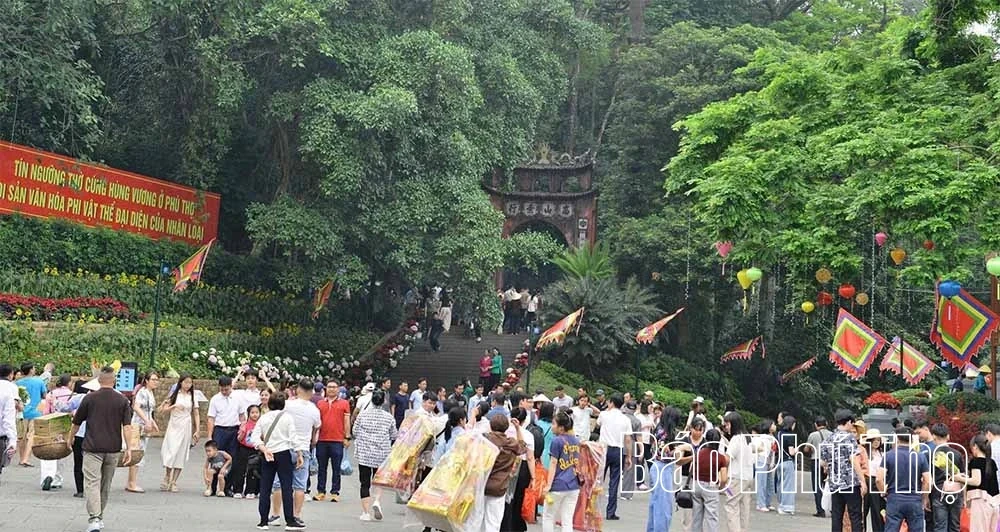
Crowds of locals and visitors flocking to the 2026 Hung Temple Festival.
Ms. Pham Viet Nga, Deputy Head of the Cultural Heritage Management Division (Department of Culture, Sports, and Tourism), stated that specific mechanisms and policies are a priority. These include support for monument restoration and stipends for site keepers. Notably, the “Socialization of Xoan Singing Preservation” model is considered a national exemplar for mobilizing resources from businesses and the public.
In the coming time, the province will continue to prepare dossiers for additional national intangible cultural heritages and coordinate the submission of Mo Muong for UNESCO recognition. Furthermore, the province aims to develop cultural-spiritual tourism routes, such as the “Back to the Roots” route: Hung Temple – Lang Suong Temple – Mother Au Co Temple.
Linking heritage with contemporary life through traditional festivals like the Tay Thien Festival and Tro Tram Festival, along with craft villages like Huong Canh pottery and Sai Nga conical hats, will help define the identity of the Northern Midland and Mountainous region. The core objective is to transform heritage into assets, serving scientific research, traditional education, and improving the local standard of living.
Upholding the teachings of Uncle Ho, the Party, government, and people of Phu Tho are sustainably preserving heritage values, ensuring that the cultural essence of the Ancestral Land remains a source of pride and a resource for future development.
Huong Lan

baophutho.vn Bound directly to the geographic cradle of Muong anthropology, straw wine (ruou can or raw toong in the indigenous tongue)—a fragrant, deeply...

baophutho.vn Phu Tho Culture Express - Lingering echoes of Muong folk singings

baophutho.vn Amidst the rapid transformations of contemporary life, diligent hands within Ren Hamlet, Dan Chu Commune, continue to safeguard the century-old...

baophutho.vn Amidst the rapid transformations of contemporary life, ancient Xoan vocal melodies continue to resonate across the Ancestral Land, seamlessly...

baophutho.vn On the morning of June 20, 2026, Vinh Thanh Commune hosted a high-protocol ceremony to formally receive the Provincial-Level Historical and...

baophutho.vn Situated within Thong Nhat Ward, the Muong Cultural Heritage Museum has long been celebrated as a miniature Muong village—a sacred sanctuary...

baophutho.vn The beauty Thai traditional costume

baophutho.vn As the sacred ancestral cradle of the Vietnamese nation, Phu Tho has long been celebrated as the custodian of an extraordinary living treasury...

baophutho.vn Phu Da stone temple - A masterpiece of stone architecture

baophutho.vn The People’s Committee of Thanh Ba Commune has officially hosted a high-profile ceremony to announce the establishment and launch of the Hanh...
Editor-in-chief: Vi Manh Hung
License No.154/GP-BTTTT dated March 3,2022 by the Ministry of Information and Communications.
Address : No.Nguyen Tat Thanh street, Viet Tri ward, Phu Tho province
Tel: (0210) 3846.508; (0210) 3855.303
Email: info@baophutho.vn
Website: baophutho.vn
Copyrights Phu Tho Newspaper; All rights reserved
