
{title}
{publish}
{head}

Rather than opting for lavish resorts, many modern tourists prefer wading through rice paddies, catching fish, or hand-picking produce to experience a day in the life of a farmer. This agritourism trend is generating a new wave that satisfies urbanites' desire to reconnect with nature while opening breakthrough avenues for the rural economy.
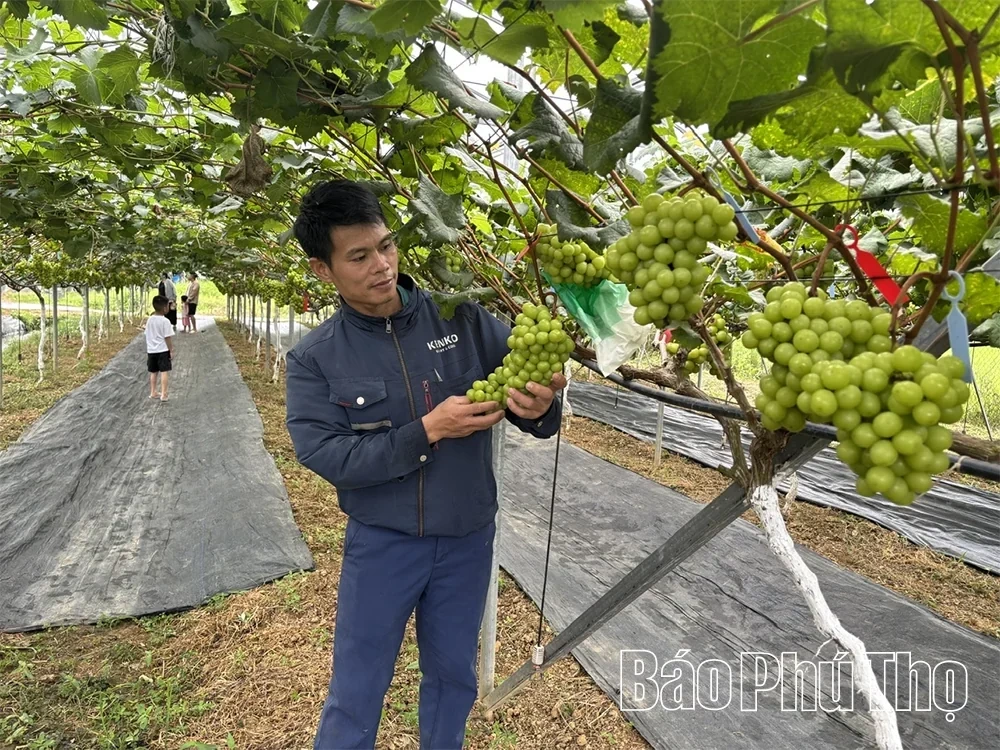
Capitalizing on green tourism trends, numerous orchards across the province have transformed traditional farmland into vibrant experiential destinations.
Catching the green tourism wave early, many farm owners across the province have quickly adapted, converting purely agricultural plots into engaging experiential destinations.
In recent days, Mr. Tran Duy Doan’s grape farm in Hai Luu Commune has emerged as an attractive spot, drawing hundreds of visitors daily. Here, guests can personally select and harvest ripe grape clusters, snap photos amidst lush surroundings, and enjoy the sweet flavor of clean, farm-fresh produce right on the spot.
Mr. Tran Duy Doan, owner of the Song Lo Clean Grape Farm, shared that to cater to urban residents' growing demand for green spaces, his family organized and invested in a 1.4-hectare area dedicated to grape cultivation and scenic landscaping. Allowing visitors to harvest grapes while introducing them to organic farming processes turns simple agricultural products into value-added services, significantly boosting income generated per land unit.
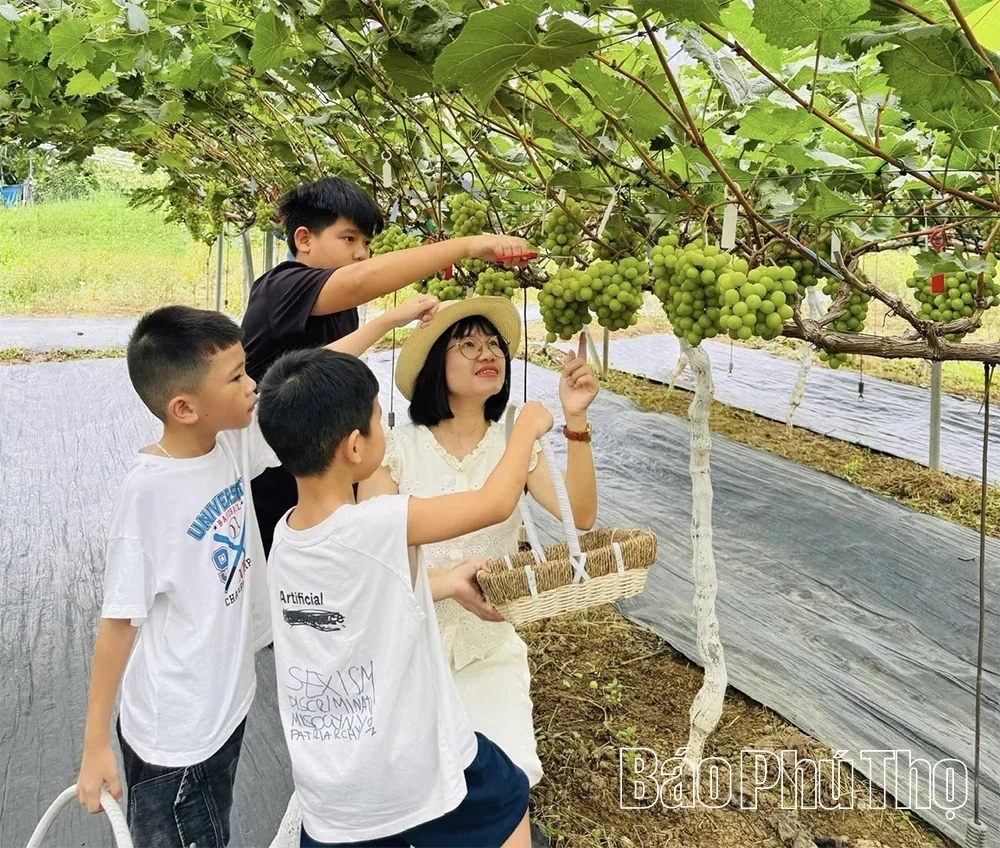
Visitors enjoy hands-on experiences at the Song Lo Clean Grape Farm in Hai Luu Commune.
Beyond rustic orchards, agritourism is making major strides toward deeper, eco-friendly models that blend circular biotechnology with sustainable development. A prime example is the Tam Dao Mushroom Cooperative in Tam Dao Commune, featuring the model “Farmers engaging in native cultural tourism tied to eco-agriculture.”
Discussing the closed-loop production chain—from mulberry orchards for silkworm rearing to culturing rooms for Cordyceps mushrooms—Mr. Nguyen Quoc Huy, Director of Tam Dao Mushroom Cooperative, emphasized their ambition to turn the farm into a visual environmental education space. The circular process optimizes by-products to reduce ecological impact while letting visitors see firsthand how science elevates traditional agriculture, spreading a strong green living message.
This creativity, innovation, and educational integration effectively address the needs of families with young children seeking outdoor alternatives to smartphone screens.
Accompanying her child on a field trip to the Tam Dao Mushroom Farm, Ms. Vu Quynh Huong, a visitor from Vinh Phuc Ward, noted that stepping away from concrete walls to touch soil, water plants, harvest fruit, and feed silkworms offers immense educational value. These outdoor activities foster physical growth and creative thinking while teaching children to value labor, appreciate farmers' efforts, and protect the environment.
Integrating agricultural production with experiential tourism is a necessary and highly effective direction that increases farm incomes while promoting local tourism. To date, the province has developed several well-invested agritourism sites that show initial positive economic signs.
Frankly speaking, however, agritourism still faces notable hurdles. Most models remain spontaneous, small-scale, and lack professional operation, limiting their appeal to tourists—especially those from outside the province. Furthermore, farm workforces consist mainly of local laborers lacking specialized training, leading to service quality limitations.
Partnerships with travel agencies to build structured tours and routes remain underdeveloped. Crucially, the biggest barrier involves land use: most operations sit on agricultural and forestry land without finalized land-use conversion procedures, hindering large-scale investment.
To address these shortcomings and build a sustainable long-term vision, relevant sectors and local authorities will strengthen coordination, modernize management, and resolve bottlenecks facing agritourism.
Key priorities include master planning to establish high-tech, eco-friendly agricultural zones along value chains that link production with eco-tourism and school education. Concurrently, the province will prioritize infrastructure investments connecting key rural areas to tourist spots, while issuing specific support policies for capital, technical transfer, and digital transformation targeting farms and cooperatives.
Above all, a core long-term strategy involves training farmers in tourism skills and cultural preservation—transforming every farmer into a welcoming tourism ambassador to drive sustainable rural economic growth.
Tran Tinh

baophutho.vn Traditional markets adapt to modern life

baophutho.vn Tucked away in a valley of the Northwest region, Lac Village in Mai Ha commune offers a peaceful scenery and a culture steeped in identity....

baophutho.vn Tho Tang - The land of heritage

baophutho.vn Far from being an expensive delicacy, Dam Vac small freshwater fish is still proudly spoken of by locals as a signature specialty of the former...

baophutho.vn Phu Tho is actively integrating OCOP (One Commune One Product) items into tourism development, gradually transforming local specialties, craft...

baophutho.vn Located about 80 km from Hanoi, Cao Phong Commune possesses many advantages for tourism development. From spiritual tourism to eco-tourism...

Stories from Muong hamlets

baophutho.vn During the 5-day September 2, 2026 National Day holiday, tourism activities across Phu Tho Province took place vibrantly, safely, politely, and...

baophutho.vn Located about a 90-minute drive from the center of Phu Tho Province, Trung Son Commune is opening up an attractive discovery journey for...

baophutho.vn Nestled peacefully beside the poetic Boi River and surrounded by rolling mountain ranges, Serena Resort Kim Boi (Hop Kim commune) is one of the...
Editor-in-chief: Vi Manh Hung
License No.154/GP-BTTTT dated March 3,2022 by the Ministry of Information and Communications.
Address : No.Nguyen Tat Thanh street, Viet Tri ward, Phu Tho province
Tel: (0210) 3846.508; (0210) 3855.303
Email: info@baophutho.vn
Website: baophutho.vn
Copyrights Phu Tho Newspaper; All rights reserved
