
{title}
{publish}
{head}

By combining traditional blacksmithing techniques with modern machinery, production establishments in Ban Mach hamlet, Vinh Phu commune, Phu Tho province are step-by-step elevating yield and product quality, saving energy, and expanding markets. Innovating production methods represents a crucial direction for traditional craft villages to maintain competitiveness and develop sustainably.
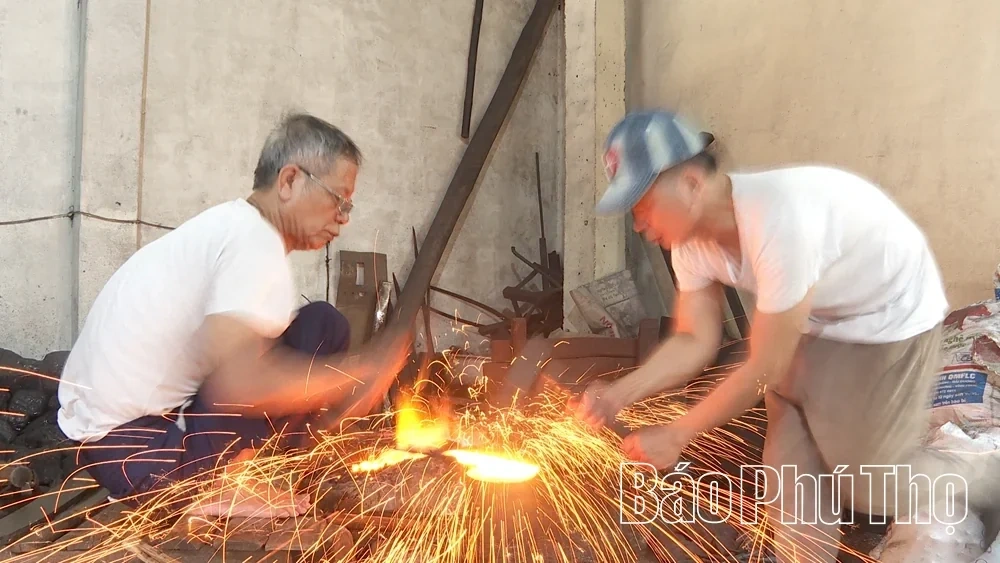
Blacksmiths of Ban Mach craft village, Vinh Phu commune preserve traditional techniques, creating products closely tied to daily life and production.
Preserving Traditional Craft Essence
The sound of hammers pounding on anvils, red embers from forging furnaces, and the nimble hands of craftsmen have become familiar scenes in Ban Mach hamlet, Vinh Phu commune. Over many generations, blacksmithing has not only provided livelihoods for residents but also contributed to preserving cultural values and labor experiences accumulated over time.
The entire commune currently features over 700 producing households, generating regular employment for approximately 1,400 workers. Daily, establishments release 20,000 to 30,000 products to the market—ranging from knives and scissors to hoes, shovels, sickles, and various tools serving agricultural production and daily living. Products are consumed not only across domestic localities but are also step-by-step reaching international markets.
To create a high-quality blacksmith product, craftsmen must undergo numerous stages—from selecting raw materials, forging steel, and shaping to quenching, sharpening, and finishing. Every stage demands meticulousness, experience, and technical control capabilities. These represent the core values helping Ban Mach craft village products maintain their market standing.
Devoting nearly half a century to the craft, artisan Vu Van Tan has witnessed many transformations in production methods. From relying primarily on manual tools, present-day establishments have applied machinery across many stages—reducing physical labor, boosting yield, and expanding product varieties.
Sharing with us, artisan Vu Van Tan stated: “Compared to the past, the blacksmith craft has undergone many changes. Modern machinery helps craftsmen face less hardship and produce far more items. However, to produce good, durable, and sharp items, craftsmen must possess experience, meticulousness, and maintain traditional techniques. I hope the younger generation continues learning and preserving the craft, knowing how to apply new technologies so the blacksmith trade can develop long-term.”
From the perspective of veteran blacksmiths, technological innovation does not equate to losing identity. Experience in handling steel, shaping, quenching, and finishing products remains the decisive quality factor. When supported by suitable equipment, traditional skills find conditions to operate with higher efficiency, while fulfilling increasingly stringent market demands.
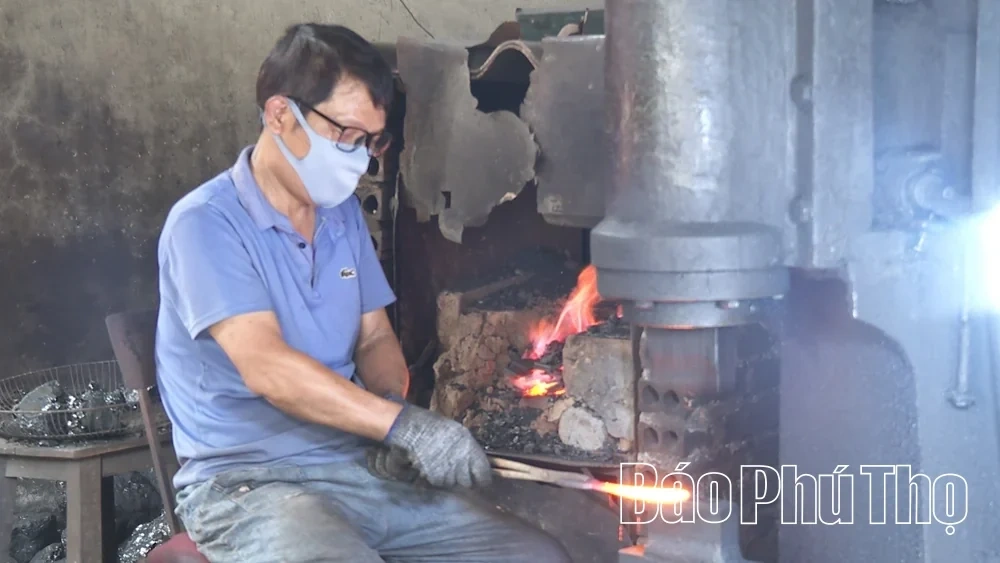
Investing in machinery helps Ban Mach craft village establishments elevate yield, reduce physical labor, and improve production efficiency.
Technological Innovation, Elevating Production Efficiency
While the majority of production stages previously relied on human muscle, today many establishments in Ban Mach have proactively invested in pneumatic hammers, cutting machines, grinding machines, and modern metal processing equipment. Certain facilities utilize sheet metal shears, press brakes, and laser cutters to fulfill orders requiring large volumes, specific dimensions, and high precision.
At the production facility of Mr. Nguyen Trung Kien, investing in new equipment provided greater autonomy in processing, shortened production cycles, and met customer needs. According to Mr. Kien, monthly electricity costs for his facility fluctuate between 25 to 30 million VND. Therefore, beside raising output, calculating machinery efficiency, reducing power consumption, and lowering costs per unit serve as crucial requirements.
Technology investments also create conditions for facilities to diversify product lines. Ms. Nguyen Thi Bay — owner of the Bay Tan traditional forge and DAKA knife brand — shared: “Previously, due to technological constraints, the facility primarily produced specialized items. With additional supporting equipment, we expanded our product catalog—from slicing knives and kitchen knives to knives serving specialized needs.”
According to Ms. Bay, the market increasingly demands high-quality products at reasonable prices. Consequently, facilities must regularly refine technology and seek innovations to raise output, reduce costs, and better fulfill client demands.
After over 30 years in the trade, Mr. Vu Duc Thang also noticed machinery creating distinct changes in production workflows—specifically reducing physical labor, boosting output, and aiding craftsmen in executing stages with higher precision. Mr. Thang stated: “I see machinery providing immense support to craftsmen, from processing to product shaping—boosting yield and reducing labor. However, machinery only yields efficiency when craftsmen know how to operate it correctly, combining it with experience and trade techniques. To develop long-term, we must elevate craftsmanship while modernizing equipment, saving raw materials and energy, and prioritizing product quality.”
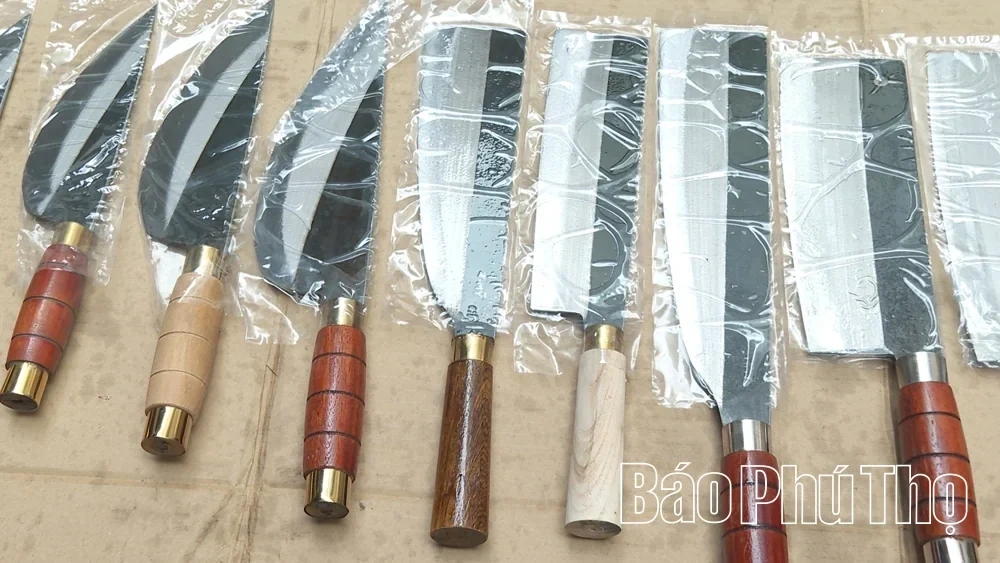
Knife products and labor tools from Ban Mach craft village contribute to affirming traditional craft values in the market.
Taking Quality as the Foundation, Heading Toward Sustainable Production and Market Expansion
Along with boosting yield, the efficient use of raw materials and energy is becoming a practical requirement for blacksmith facilities. In the context of rising input costs, the rational utilization of steel billets, minimizing waste in every stage, and recycling metal scrap contribute to lowering cost prices and raising production and business efficiency. Investing in suitable machinery, updating heating equipment, and applying energy-saving technologies also open directions for facilities to lower fuel consumption and elevate production efficiency. Among these, high-frequency induction furnaces can shorten heating times and utilize energy more efficiently when operated according to proper procedures and aligned with practical conditions.
Beside technological innovation, facilities must focus on controlling smoke, dust, noise, collecting waste, ensuring workshop ventilation, and equipping workers with protective gear. Sustainable production does not stop at cost savings but demands safe operational procedures, regular equipment maintenance, and environmental protection measures suited to production scales.
The consumer market also imposes increasingly high requirements on quality, durability, usability, and product pricing. Therefore, beside increasing output, craft village facilities must focus on improving designs, controlling quality, and building brand prestige.
Several facilities have proactively promoted products on social media and e-commerce platforms, combining traditional distribution methods with warranty services and return/exchange support to expand markets and build customer trust. Product quality alongside post-sale services serve as crucial factors helping facilities retain clients.
Ms. Vu Thi Sinh, a frequent customer using craft village products, evaluated the merchandise as diverse, reasonably priced, and fulfilling usage needs. Meanwhile, Ms. Nong Thi Luyen shared that she researched and purchased DAKA brand knives via online platforms, offering positive feedback regarding pricing as well as the facility’s defect-exchange and warranty policies.
Consumer feedback indicates that elevating product quality, perfecting services, and diversifying distribution channels represent necessary directions for Ban Mach craft village to increase competitiveness. This also serves as motivation for manufacturing households to step-by-step innovate business methods, linking production activities with market demands toward stable and sustainable development.
Accompanying Craft Village Development
For positive transformations to be maintained and scaled, alongside the proactiveness of manufacturing households, the companionship of government and specialized agencies plays a vital role—especially in supporting technology innovation and elevating energy efficiency.
According to Mr. Nguyen Viet Tien — Deputy Head of the Economic Division of Vinh Phu commune, over the past period, the Commune People’s Committee coordinated with the Provincial Industrial Promotion Center to register support for 3 households to purchase new machinery, with a total investment capital of 615 million VND.
Moving forward, the locality will continue guiding households in formulating projects, accessing industrial promotion policies, and investing in energy-saving equipment to improve production efficiency.
Support must link with the practical demands of each facility, prioritizing equipment capable of raising output, reducing material and energy consumption, and suiting production scales. Concurrently, it is essential to strengthen technical guidance on operating and maintaining machinery, implementing occupational safety, and protecting the environment.
On the part of manufacturing households, innovation needs to follow a roadmap appropriate for financial capacity and product outlets. Equipment investment must go hand in hand with workflow improvements, skill elevation, brand building, and distribution channel expansion. When these factors are deployed synchronously, the efficiency of support policies can translate into long-term competitive strength for the craft village.
From traditional blacksmith forges to modern processing equipment, Ban Mach craft village is step-by-step adapting to new development demands. Preserving the craft today is not merely maintaining techniques passed down through generations, but also innovating production methods, efficiently utilizing resources, and elevating environmental responsibility.
When product quality is prioritized, suitable technology selected, and facilities receive necessary support, Ban Mach craft village in Vinh Phu commune will possess additional conditions to develop stably, creating employment for local residents and making positive contributions toward Phu Tho province’s goal of developing green, efficient, and sustainable industry.
Quang Minh - Tien Chung

baophutho.vn Phu Tho Culture Express - Hoa Binh lake opens up new path to the future

baophutho.vn Phu Tho Culture Express - Humble countryside gifts

baophutho.vn On the morning of October 25, the Hung Temple Historical Relic Site coordinated with VietTimes Events and Media Co., Ltd. and IGO Binh Minh...

baophutho.vn Needle stitches through time

baophutho.vn Phu Tho Culture Express - Phu Tho preserving heritage in association with sustainable development

baophutho.vn Muong Be in doi harvest season

In the cultural treasure trove of the Muong ethnic people in Thanh Son, folk performing arts are closely linked to community life, customs, and religious activities. Gong...

baophutho.vn Phu Tho Culture Express: The essence of Muong ceramic

baophutho.vn With just over a week remaining, the 2026 Mien Doi Terraced Field Festival will officially take place in Thuong Coc Commune. At this time,...

baophutho.vn Dan Chu - Drawing on heritage moving confidently towards the future
Editor-in-chief: Vi Manh Hung
License No.154/GP-BTTTT dated March 3,2022 by the Ministry of Information and Communications.
Address : No.Nguyen Tat Thanh street, Viet Tri ward, Phu Tho province
Tel: (0210) 3846.508; (0210) 3855.303
Email: info@baophutho.vn
Website: baophutho.vn
Copyrights Phu Tho Newspaper; All rights reserved
