


{title}
{publish}
{head}

Every spring, as the mist lingers over the surface of Hoa Binh Lake, thousands of pilgrims from across the country eagerly board boats and head upstream to visit the Thac Bo Goddess Temple.
The Thac Bo Goddess Temple area on Hoa Binh Lake.
From the early morning of spring’s first days, Thung Nai wharf (Thung Nai commune) and Bich Ha port (Hoa Binh ward) are bustling with people and vehicles. The roar of boat engines blending with the sound of water lapping against the hulls creates a vibrant atmosphere unique to the Thac Bo Goddess Temple festival season. At the wharves, tourists carry ritual offerings and fresh spring branches, their faces glowing with excitement for the year’s first excursion.
Boats trail one after another, carrying crowds across the vast expanse of water. Along the banks, undulating limestone ranges reflect on the emerald water, with occasional glimpses of peaceful stilt houses belonging to the Muong and Dao ethnic groups nestled in the valleys. The open, airy space leads many visitors to describe the pilgrimage to Thac Bo Goddess Temple as a "waterborne pilgrimage."
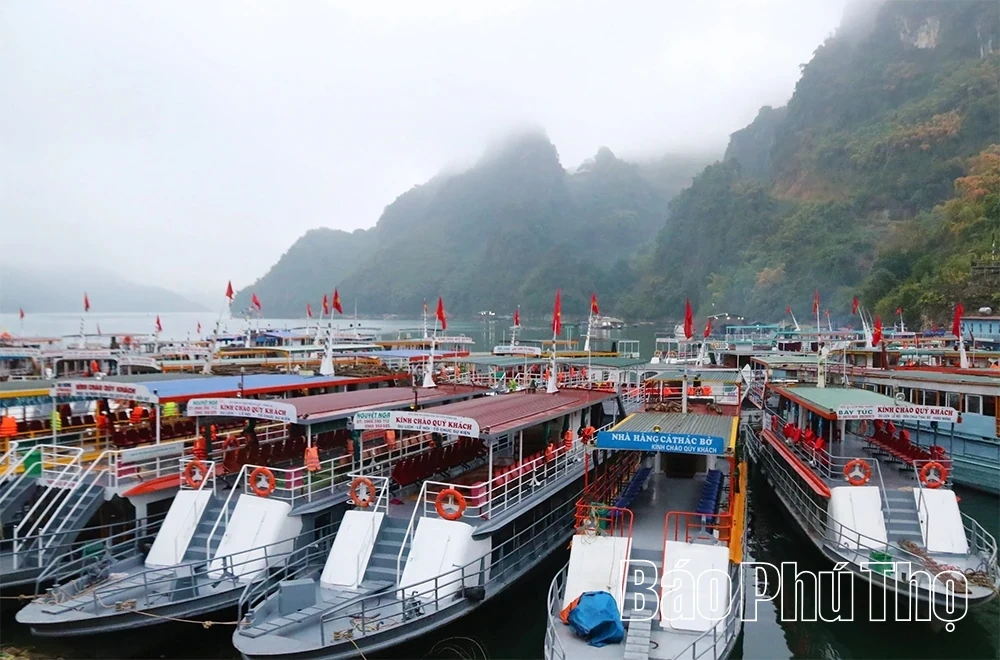
Boats pick up spring tourists at Bich Ha port, Hoa Binh ward.
The temple attracts not only locals but also a massive number of visitors from provinces across Vietnam. Many families choose this spring pilgrimage as a way to start a peaceful and lucky new year, combining it with leisure and nature sightseeing. "It’s both a pilgrimage and a spring outing—a chance to sightsee and relax. Sitting on a boat in the middle of the lake, I feel a sense of profound relief," shared Ms. Nguyen Thi Hanh, a tourist from Hanoi.
Thac Bo Goddess Temple—one of the most sacred temples in the Northwest—is located in Thung Nai and Tien Phong communes, perched on a limestone mountainside overlooking Hoa Binh Lake. The temple honors the Goddess of Thac Bo, a figure deeply revered by the people and associated with the history of the once-perilous Da River.
According to legend, the temple honors two heroines: Ms. Dinh Thi Van, of the Muong ethnic group, and a Dao woman from Vay Nua. They were instrumental in assisting King Le Loi with food supplies and boats to cross the Bo rapids, enabling his army to advance to Muong Le (Son La) and quell the rebellion of Deo Cat Han. After their passing, they frequently manifested to help locals navigate the rapids safely and blessed the region with favorable weather. In recognition of their merits, King Le Loi bestowed titles upon them and ordered the people to build a temple in their memory.
Through historical changes, especially since the formation of the Hoa Binh Hydropower plant, Thac Bo Goddess Temple has become a vital spiritual anchor for the people in the reservoir area. The Thac Bo Temple Festival typically lasts from the first to the third lunar month, peaking in early spring.
In this sacred space, visitors respectfully offer incense to pray for peace, fortune, and health for their families. Offerings are usually simple yet solemn, consisting of incense, flowers, betel leaves, and fruits, reflecting the beautiful traditional beliefs of the Vietnamese people.
In recent years, local authorities have focused on organizing the festival in a civilized and economical manner. Synchronous efforts such as discouraging excessive burning of votive paper, protecting environmental hygiene, and ensuring waterway traffic safety have left a positive impression on visitors.
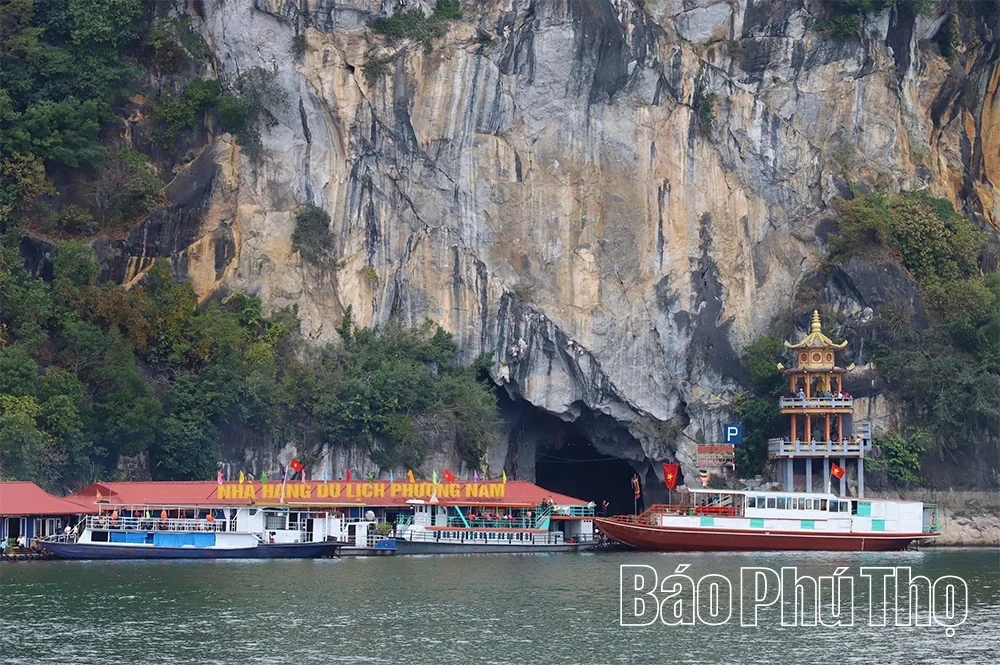
Mystical Thac Bo Cave Amidst the Heart of the Mountain
Not far from the Goddess Temple is Thac Bo Cave, an indispensable stop in the early spring journey. From the boat wharf, visitors follow stone steps leading up to the cave entrance. Inside, a mystical space unfolds with a system of natural stalactites in unique shapes.
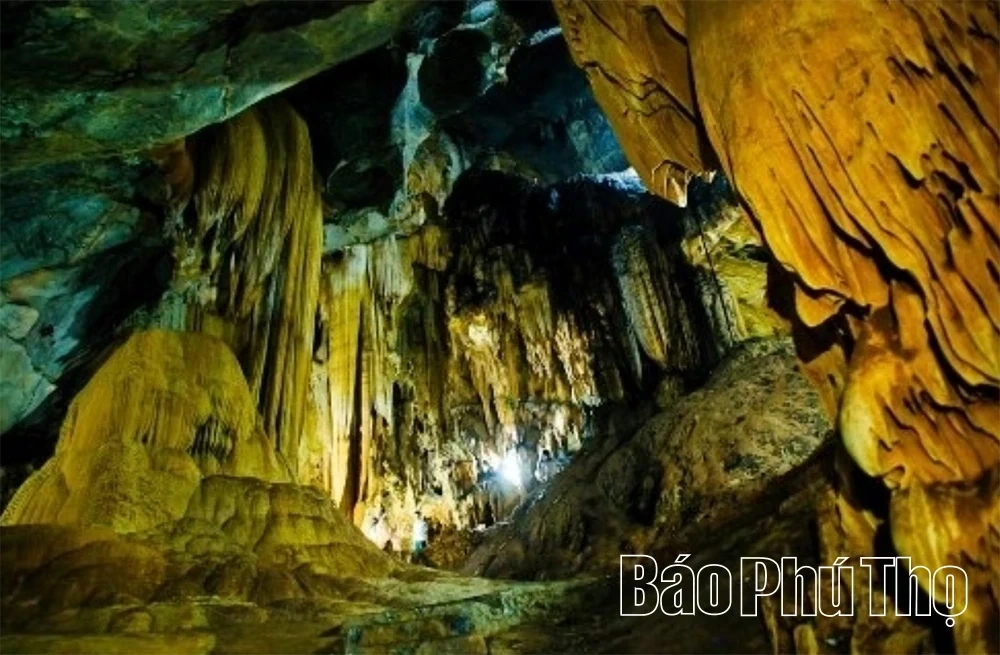
Thac Bo Cave—an ideal place to discover the beauty of nature.
Thac Bo Cave was recognized as a National Heritage site in 2008 by the Ministry of Culture, Sports, and Tourism.
In folk belief, Thac Bo Cave is not only a natural wonder but also holds deep spiritual significance. Many stalactite formations are named “gold tree,” “silver tree,” “elephant herd,” or “sitting Buddha,” associated with aspirations for wealth and blessings.
Beyond serving spiritual needs, Thac Bo Cave is a highlight in ecotourism development. The combination of cave exploration, temple visits, and lake excursions creates a unique tourism product that attracts visitors year-round, especially in early spring.
Specialty fish from Hoa Binh Lake.
Local products served to tourists on Hoa Binh Lake.
Mr. Tran Anh, Party Secretary of Thung Nai Commune, stated: "Each festival season, Thac Bo Goddess Temple welcomes tens of thousands of visitors. The commune has coordinated with functional forces to strengthen management, ensure security, waterway safety, and preserve the landscape. Our goal is to develop spiritual tourism in tandem with preserving traditional cultural values and the lake’s ecology. Locals are encouraged to participate in tourism services in a civilized and friendly manner, treating tourists as honored guests of their homeland."
Hong Trung

baophutho.vn Khap singing the Tay people in Duc Nhan

A cultural tourism destination showcating H’Mông heritage

baophutho.vn In the vibrant atmosphere of the Whale Festival (Lễ Cầu Ngư) on the afternoon of May 7, a motorized inflatable boat performance by the Hoa Binh...

baophutho.vn Leveraging the abundant aquatic resources of the Da River, fish floss products from Hai Dang Group Co., Ltd. (Hoa Binh Ward) are steadily...

baophutho.vn According to data from the Phu Tho Department of Culture, Sports, and Tourism, during the April 30 - May 1, 2026 holiday, the province is...

baophutho.vn Located in seclusion amidst Dai Lai Lake, Ngoc Island (Pearl Island) has long been regarded as the "green gem" of Phu Tho tourism. Spanning 3.7...

baophutho.vn With majestic landscapes and fresh mountain air, Toan Thang Commune is emerging as an attractive destination, offering tourists relaxing...

baophutho.vn Amidst the hustle and bustle of modern life, Lac Village remains a sanctuary of pristine beauty—a place where the breath of nature and the...

Preserving the cultural identity of Mo Muong in the rhythm of modern life

baophutho.vn In the new development space, as Phu Tho expands its scale and repositions itself in regional linkages, tourism is no longer just a service...
Editor-in-chief: Vi Manh Hung
License No.154/GP-BTTTT dated March 3,2022 by the Ministry of Information and Communications.
Address : No.Nguyen Tat Thanh street, Viet Tri ward, Phu Tho province
Tel: (0210) 3846.508; (0210) 3855.303
Email: info@baophutho.vn
Website: baophutho.vn
Copyrights Phu Tho Newspaper; All rights reserved
