

{title}
{publish}
{head}

With a long history and a rich value system, the culture of the Muong ethnic group is not only a precious asset of the community but also a vital component of the Ancestral Land’s identity. The preservation of these values across generations, combined with the government’s decisive efforts in restoring and promoting heritage, has transformed culture into an endogenous strength. This power drives socio-economic development and strengthens community cohesion within a new developmental landscape.
The 2026 Muong Khai Ha Festival was organized on a provincial scale, contributing to the spread of traditional cultural values.
Khai Ha Festival: Vitality in a Developing Space
Within the intangible cultural heritage system of the Muong people, the Khai Ha Festival holds a position of paramount importance, acting as a thread that connects the community and awakens national pride. More than a simple religious ritual to pray for favorable weather and bountiful harvests, it has evolved into a unique cultural tourism product, carrying the indigenous people’s aspirations for a prosperous and happy life.
Under the two-level local government model, the innovation in administrative management has not only improved operational efficiency but also created new responsibilities and opportunities for cultural preservation. According to Mr. Le Chi Huyen — Chairman of the Muong Bi Commune People’s Committee — this restructuring allows for closer grassroots supervision, ensuring that culture truly serves as the spiritual foundation and a resource for development.
The 2026 Khai Ha Festival, held on a provincial scale, showcased a powerful convergence of heritage. The festival space was not confined to a single area but became a bridge between ancient Muong regions, featuring exchanges from various localities such as Thanh Son, Tu Vu, Song Lo, and Van Phu Ward. This connection created a cultural space that is both diverse and unified, affirming the tight-knit spirit among ethnic groups in the Ancestral Land. Through cultural activities, sports, and folk games, the image of a “Sincere - Dynamic - Integrated” Phu Tho has been widely promoted to visitors.
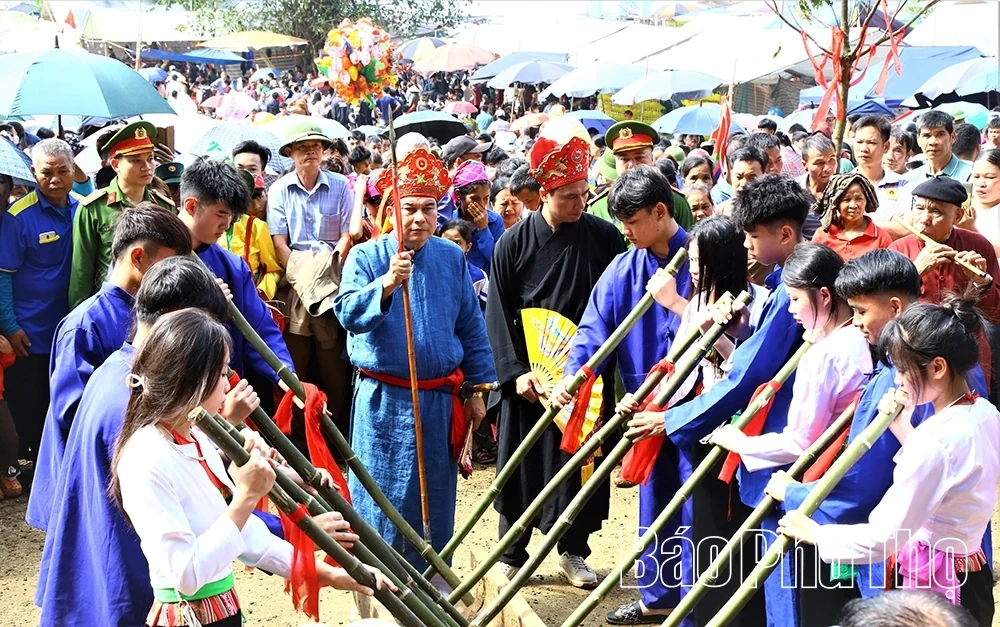
The Dinh Khenh Festival (Thuong Coc Commune) is organized to help preserve and promote the Muong ethnic cultural values in the area.
Affirming Identity and Preservation Efforts
In recent years, the preservation of Muong culture has received special attention from authorities and the cultural sector. Key characteristics such as language, traditional attire, stilt house architecture, and indigenous knowledge systems have been strictly inventoried and assessed. Notably, Mo Muong — a ritual performance reflecting the community’s worldview and outlook on life — has been included in the National Intangible Cultural Heritage List, with a dossier submitted to UNESCO for urgent safeguarding.
Alongside Mo Muong, the art of Muong Gongs is a source of immense pride, with over 10,000 gongs currently used and practiced by the community. Other intangible heritages have also been recognized at the national level, including: Bamboo calendar folk knowledge; the art of creating patterns on skirt waistbands; Thuong rang and Bo meng singing; and unique festivals like the Kén-snatching festival (Tho Van Commune) and Tet Doi (Thu Cuc Commune).
Preservation work has been implemented through various comprehensive forms. The province has issued guiding documents and developed long-term plans to integrate Muong cultural preservation into New Rural Development programs and socio-economic growth strategies.
Beside these policy frameworks, the province focuses on inventorying, collecting, digitalizing, and establishing scientific dossiers for typical cultural values. Significant emphasis is placed on honoring and supporting artisans—the direct “keepers of the heritage fire”—with dozens of individuals being awarded the prestigious title of "Meritorious Artisan."
Furthermore, heritage is actively introduced into educational environments through specialized classes that teach the Muong language, its script, and traditional folk melodies.
Specifically, the direction of linking cultural preservation with community-based tourism has proven highly effective. Many Muong villages have become popular destinations where tourists can experience traditional stilt houses, enjoy unique cuisine, and immerse themselves in folk activities. This provides local people with sustainable income and reinforces their pride in their ethnic identity.
Despite these achievements, the work still faces challenges from urbanization and modern life. To address this, the province is determined that preservation must be linked to people’s livelihoods. In key areas like Muong Bi, Muong Vang, Muong Thang, and Muong Dong, the restoration of rituals, weaving crafts, and language teaching is being intensified. Moving forward, the province will focus on applying digital technology to store and promote Muong cultural documents and build community museum models. This close bond between heritage and sustainable tourism is the path for Phu Tho’s Muong culture to reach further and remain a valuable legacy for future generations.
Huong Lan

baophutho.vn Phu Tho is an ancient land—the cradle of the Vietnamese nation—and a focal point for a rich treasure trove of Intangible Cultural Heritage...

baophutho.vn The legacy of Dinh Bo Linh on the ancestral land

baophutho.vn For generations, the Hung King Worship Belief has become a sacred symbol in the spiritual life of the Vietnamese people. Beyond reflecting the...

baophutho.vn The vibrant patterns of Muong land

baophutho.vn During the third lunar month, millions of Vietnamese hearts turn toward the Hung Temple Special National Historic Site. This site is not only a...

baophutho.vn In the Vietnamese subconscious, the Hung Kings' Commemoration is more than just a holiday; it is a sacred spiritual symbol that crystallizes...

baophutho.vn In June 2025, the folk performing arts of Thuong Rang and Bo Meng singing of the Muong people were officially recognized by the Ministry of...

baophutho.vn This year’s Street Folk Festival was organized on a grand scale, gathering over 1,500 artisans and performers from 18 representative clusters...

baophutho.vn Bach Temple - History and spirituality

baophutho.vn On the morning of April 25 (the 9th day of the 3rd lunar month), Van Phu Ward solemnly organized the Hung Lo Communal House Palanquin...
Editor-in-chief: Vi Manh Hung
License No.154/GP-BTTTT dated March 3,2022 by the Ministry of Information and Communications.
Address : No.Nguyen Tat Thanh street, Viet Tri ward, Phu Tho province
Tel: (0210) 3846.508; (0210) 3855.303
Email: info@baophutho.vn
Website: baophutho.vn
Copyrights Phu Tho Newspaper; All rights reserved
