

{title}
{publish}
{head}

Phu Tho is currently architecting its development path with a clear mandate: developing industry without compromising the environment and ensuring growth remains “green” from its very foundation. This is a challenging choice that requires the province to depart from traditional models and set higher standards for the entire system. Yet, within this transformation, a new direction is emerging—a path toward a greener, modern, and more sustainable industrial landscape.
An aerial view of Ba Thien II Industrial Park
From above, the Viet Tri - Tam Nong - Phu Ninh axis reveals new industrial highlights spreading across land once dominated by corn and rice. Following the merger, Phu Tho has become one of the localities with the largest industrial park (IP) networks in the Capital Region: 28 established IPs, 17 in operation, and 5 under construction. Mr. Hoang Long Bien, Director of the Provincial Industrial Zones Management Board, describes this as an "unprecedented expansion of development space."
This mindset is evident from the planning phase. In 2025, a series of 1/2000 scale zonal plans for IPs such as Thanh Ba, Yen Lac, Dong Soc, and Lien Hoa - Lien Son were finalized. These mark the transition to a new generation of “Green IPs”: integrated green corridors and water bodies, traffic networks separated from residential areas, closed-loop wastewater treatment systems, and 24/7 automated environmental monitoring. What was once a “high standard” has now become a mandatory condition for entry.
"Planning must be green. Phu Tho has chosen the most difficult path: tightening standards and monitoring upfront so that businesses enter a transparent and long-term environment," Mr. Bien analyzed.
This philosophy led to decisive actions, most notably the relocation of 11 factories from the “inner city” of Viet Tri to IPs with modern environmental infrastructure like Trung Ha II. Clean space is returned to the urban soul, while new IPs become “safe harbors” for low-emission, high-tech sectors.
As Green IPs take shape, this difficult choice is creating a solid foundation for the future. In 2025, Phu Tho attracted high-quality FDI, including Jahwa ($100M), Allied Circuit Meiko ($77M), and JH Vina (capital increase of $150M), forming a low-emission electronics component production chain. These projects do more than bring economic value; they define the “Green DNA” for the province’s next-generation industrial space.
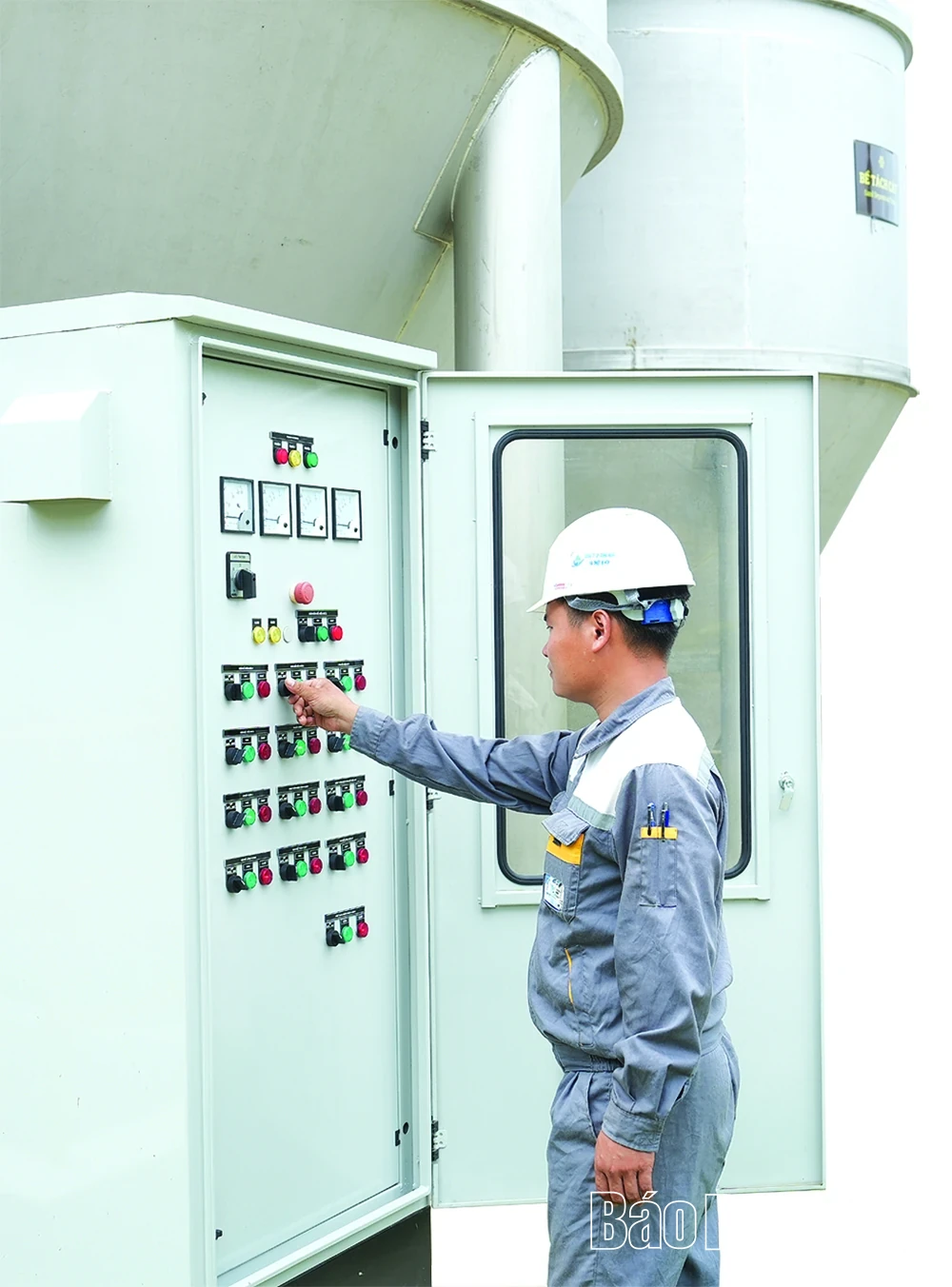
An engineer operates the centralized wastewater monitoring and treatment system at Tien Tien Industrial Park.
Chairman of the Provincial People’s Committee Tran Duy Dong identified a guiding principle: Vietnam’s commitment at COP26 to reach Net Zero by 2050 is not just a national goal but a responsibility for every locality. Therefore, Phu Tho must choose a sustainable path where economy, society, and environment are held in balance.
If planning and infrastructure are the “backbone” of green industry, businesses are the "heartbeat." In the first 11 months of 2025, 68 projects went into operation, including 48 FDI projects in the electronics and components sector. This capital shift shows a clear trend: businesses need a clean environment to increase competitiveness, and the province needs clean technology for long-term growth. Both meet at a single standard: The Green Standard.
Green businesses cannot thrive if procedures and institutions are sluggish. Thus, administrative reform is considered the “third pillar” of the green industrial ecosystem. In 2025, the Industrial Zones Management Board processed 100% of files on time or early, reducing processing time by 30%. Furthermore, a “Digital Industrial Map” was launched, allowing investors to pinpoint exactly the land fund, infrastructure, and environmental status of each zone.
This orientation is concretized in the Provincial Party Congress Resolution: By 2030, Phu Tho must become the green – sustainable – high-tech industrial center of the Capital Region. Environmental targets have been raised accordingly: 100% of IPs meeting environmental standards, 100% of hazardous waste treated, and all new projects mandated to use modern, low-emission technology.
Phu Tho’s industrial flow is shifting direction: from quantity-based expansion to quality-led development, and from “hot growth” to green growth—where every project is chosen not just for its capital, but for the future.
Nguyen Yen

baophutho.vn With the spirit of accompanying, listening to, and promptly addressing difficulties faced by the business community, Phu Tho Province’s...

baophutho.vn The "Xuan Son Early Mist Tea" portfolio, masterminded by the Xuan Dai Agro-Forestry Services Cooperative, has systematically secured a...

baophutho.vn In response to the new requirements of international integration, the implementation of Politburo Resolution No. 59-NQ/TW on international...

baophutho.vn Built upon a strong industrial foundation established over many years and enhanced by new advantages following administrative consolidation,...

baophutho.vn In recent years, agricultural production has faced numerous challenges due to adverse weather conditions and increasingly complex outbreaks of...

baophutho.vn Recognizing the Capital Region Transport Infrastructure Project as a strategic key project, authorities at all levels across the province have...

baophutho.vn The year 2026 marks a significant milestone as Viet Nam and the Kingdom of Thailand celebrate the 50th anniversary of the establishment of...

baophutho.vn On June 17, a delegation from the Ministry of Agriculture and Forestry of the Republic of Angola, led by Minister Isaac Francisco Maria dos...

baophutho.vn On June 15, 2026, the Department of Industry and Trade hosted a high-protocol ceremony to officially announce and hand over the founding...

baophutho.vn As part of its economic transformation strategy, Phu Tho Province is gradually integrating artificial intelligence (AI) into manufacturing,...
Editor-in-chief: Vi Manh Hung
License No.154/GP-BTTTT dated March 3,2022 by the Ministry of Information and Communications.
Address : No.Nguyen Tat Thanh street, Viet Tri ward, Phu Tho province
Tel: (0210) 3846.508; (0210) 3855.303
Email: info@baophutho.vn
Website: baophutho.vn
Copyrights Phu Tho Newspaper; All rights reserved
