
{title}
{publish}
{head}

Amidst the shifting dynamics of the modern market, the jars of tuong nep (sweet glutinous rice paste) crafted by the Thuy Phuong Clean Food Cooperative in Tien Lu Commune continue to captivate consumers with their rich, deeply savory, and authentically aromatic profile. By standardizing its modern manufacturing line while fiercely respecting age-old proprietary secrets, the cooperative has secured a 3-star OCOP certification for its product. This achievement opens up a highly promising roadmap for preserving traditional culinary heritage and generating sustainable, green livelihoods for the local citizenry.
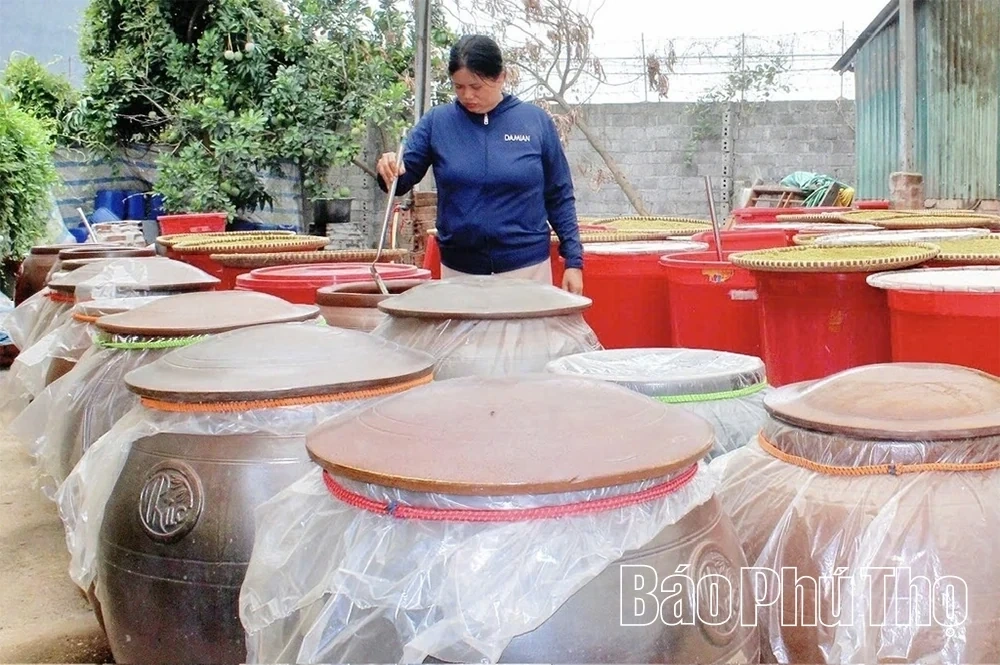
Mrs. Khuong Thi Ly — Director of the Thuy Phuong Clean Food Cooperative — audits the quality of sweet glutinous rice paste jars during the natural fermentation and aging pipeline.
To distill amber-colored, naturally sweet, and intensely aromatic drops of rice paste, Thuy Phuong’s manufacturing pipeline mandates painstaking attention to detail right from the raw material entry. Mrs. Khuong Thi Ly — Director of the Cooperative — shared: "In the craft of fermenting rice paste, raw materials act as the definitive soul that dictates over half the success of a koji-mold batch. Previously, we utilized local sticky rice or Thai glutinous variants, but we have now completely transitioned to Japanese sake/short-grain rice. This grain offers an exceptionally airy, translucent, and elastic texture that does not clump on the exterior. Consequently, during the koji-cultivation phase, the rice achieves perfect granularity without sticking together."
This breakthrough shift to Japanese rice optimizes the physical structure of the mold bed, creating ideal conditions for beneficial yeast spores to proliferate uniformly from the core to the surface. In tandem with the rice, soybeans are selectively sourced from verified clean agricultural zones. Every bean must be plump and free of pests, then roasted to a precise degree using a proprietary secret to unlock a pure, toasted aroma without any hint of scorching.
Following raw material selection, the cultivation and nurturing of the koji mold is regarded as the most sophisticated, experience-heavy challenge for artisans. Relying entirely on natural fermentation introduces a heavy dependency on climate variations, forcing craftsmen to monitor temperature and atmospheric humidity shifts hour by hour. Artisans must turn the mold beds by hand at precise intervals to ensure each rice grain absorbs sufficient oxygen, fermenting evenly to achieve the perfect golden mold hue.
This mold-cultivating phase serves as the master key dictating the final quality of the entire rice paste batch. If the mold is harvested prematurely or suffers bacterial contamination, the paste will turn sour, dull in color, and spoil rapidly. Conversely, a flawless mold batch that reaches absolute biological maturity triggers a thorough, natural saccharification process. This unlocks the clean, elegant sweetness of the starch without requiring any artificial sweeteners.
Recognizing that relying solely on manual methods makes it difficult to guarantee product consistency during large-scale manufacturing, the Thuy Phuong Clean Food Cooperative has proactively invested in modern machinery to standardize its operations. Advanced equipment, including heavy-duty industrial steaming cabinets for koji preparation and automated soybean roasters, has been successfully deployed. This seamless cross-over between modern technology and traditional craftsmanship not only liberates manual labor and upscales productivity but also guarantees a rigid control baseline for food safety and hygiene metrics.
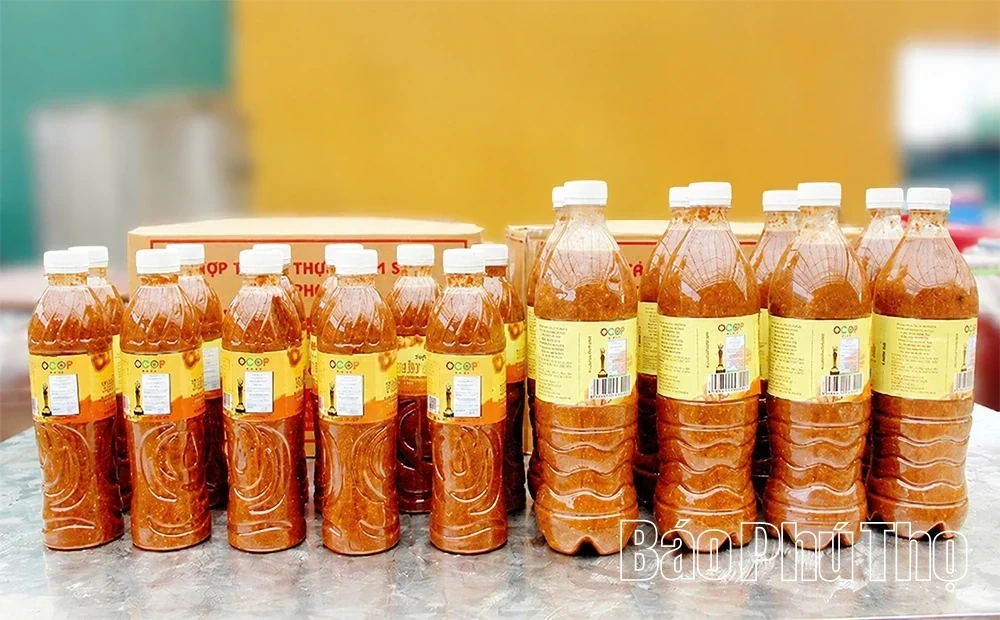
The refined, naturally sweet, and savory flavor profile of Thuy Phuong sweet glutinous rice paste has successfully won over a broad base of consumers inside and outside the province.
These structured investments yielded sweet fruits when Thuy Phuong sweet glutinous rice paste formally secured a 3-star OCOP certification in 2019. This vital commercial passport rapidly consolidated the brand’s market equity, allowing the cooperative to maintain a steady output of approximately 2,500 liters per month, driving the bulk of its nearly 700 million VND annual revenue. Concurrently, distribution has broken past traditional intra-provincial boundaries to win the trust of consumers across adjacent provinces and cities.
Despite these breakthroughs, the growth trajectory of Thuy Phuong rice paste still encounters certain distribution bottlenecks. The commercial output remains heavily dependent on intra-provincial dealer networks, while extra-provincial channels are predominantly comprised of fragmented, small-scale wholesalers. This barrier stems from a temporary shortage of capital reserves needed to scale up manufacturing, coupled with thin trade promotion capacities and unsynchronized support mechanisms to access major retail supermarkets.
Mrs. Khuong Thi Ly added: "To empower Thuy Phuong rice paste and local agricultural products to break out aggressively, our cooperative looks forward to receiving continuous support from local authorities. Specifically, we require access to preferential capital and specialized machinery, such as automated liquid-filling systems. Concurrently, creating favorable conditions for the cooperative to participate in national trade promotion fairs and amplifying media campaigns will help our brand acquire fresh, diverse demographics of clients."
In the upcoming phase, alongside sustaining and upgrading the quality of its core sweet glutinous rice paste, the cooperative will aggressively expand an ecosystem of complementary high-end products. This portfolio includes Thuy Phuong premium rice vinegar, traditional fish sauce, and local specialty fermented pork and fish coated in roasted rice powder. This proactive commitment to portfolio diversification and quality enhancement stands as a vital strategic pivot. It will upscale the value chain of local agricultural goods, enhance incomes for cooperative members, and enrich the high-quality specialty map of the province.
Tran Tinh

baophutho.vn For decades, the Hai Luu Stork Sanctuary (Hai Luu Commune, Phu Tho Province) has been widely recognized as a highly unique eco-tourism hotspot,...

baophutho.vn Rolling mountain chains, deep emerald old-growth forests, winding terraced rice paddies, and small hamlets nestled under pristine valleys form...

baophutho.vn In recent years, alongside the rigorous preservation and promotion of its distinctive cultural assets, Phu Tho's hospitality sector has been...

baophutho.vn Entering a new stage of development with an expanded regional connectivity framework, Phu Tho’s tourism sector recorded encouraging results...

The artisans keeping Muong culture alive

baophutho.vn "Transitioning tea cultivation toward organic standards and upscaling product quality to drive green tourism, while systematically expanding...

baophutho.vn During the first six months of 2026, Phu Tho Province’s tourism sector recorded positive results thanks to a series of effective tourism...

Traditional identity in modern life

baophutho.vn “Transforming tea production toward organic cultivation, improving product quality, promoting green tourism, and gradually bringing Long Coc...

baophutho.vn Amidst the vibrant, bustling rhythm of Vinh Phuc Ward, Dam Vac emerges as a precious green jewel, offering an invigorating ecological sanctuary...
Editor-in-chief: Vi Manh Hung
License No.154/GP-BTTTT dated March 3,2022 by the Ministry of Information and Communications.
Address : No.Nguyen Tat Thanh street, Viet Tri ward, Phu Tho province
Tel: (0210) 3846.508; (0210) 3855.303
Email: info@baophutho.vn
Website: baophutho.vn
Copyrights Phu Tho Newspaper; All rights reserved
