
{title}
{publish}
{head}

Amidst the vast, undulating waters of Hoa Binh Lake, where rolling mountain ranges cast their reflections onto the majestic Da River, the Thac Bo Goddess Temple has long stood as a legendary spiritual sanctuary in the Northwest region. Beyond preserving distinctive historical and cultural footprints, this sacred complex serves as a peaceful haven where locals and cross-regional travelers gather to anchor their faith and invoke blessings for luck, health, and harmony.
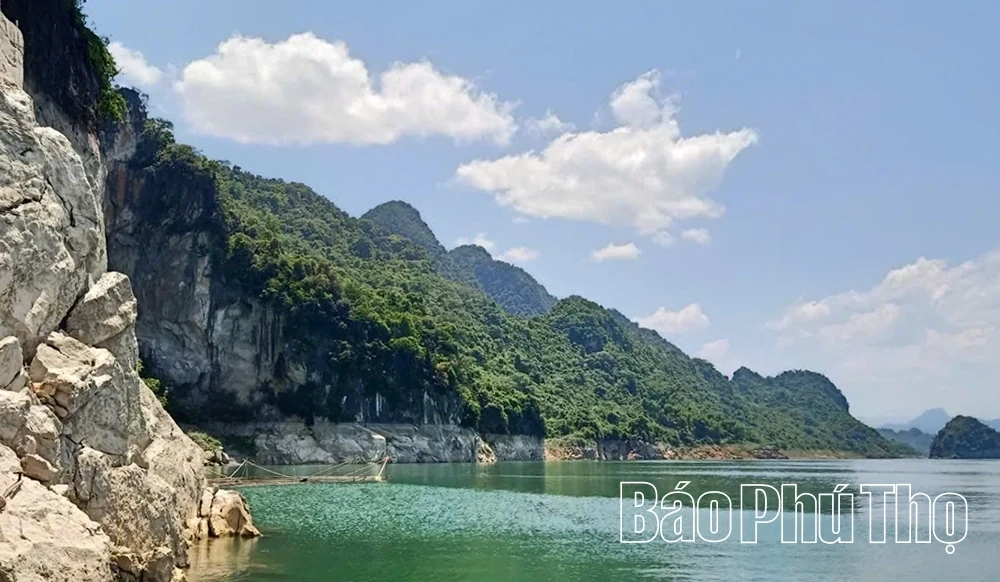
Hoa Binh Lake is widely celebrated as a “Ha Long Bay on the mountains,” captivating hearts with its breathtaking natural grandeur.
A Spiritual Haven Nested Within the Heart of Hoa Binh Lake
The defining hallmark of this historical site is the co-existence of two separate temples dedicated to the Goddess of Thac Bo: one nestled in Tien Phong Commune and the other in Thung Nai Commune. Perched along the scenic banks of Hoa Binh Lake, both structures were erected atop the foundational ruins of ancient, centuries-old shrines that predated the massive water-inflow phase of the Hoa Binh Hydropower Plant project.
While each temple features its own architectural geometry and spatial atmosphere, both stand as sacred monuments honoring the memory of two heroic women. These historical figures were instrumental in helping King Le Loi transport military provisions and guiding the insurgent army through the treacherous, bone-chilling rapids of the Da River during the resistance war against the Ming invaders.
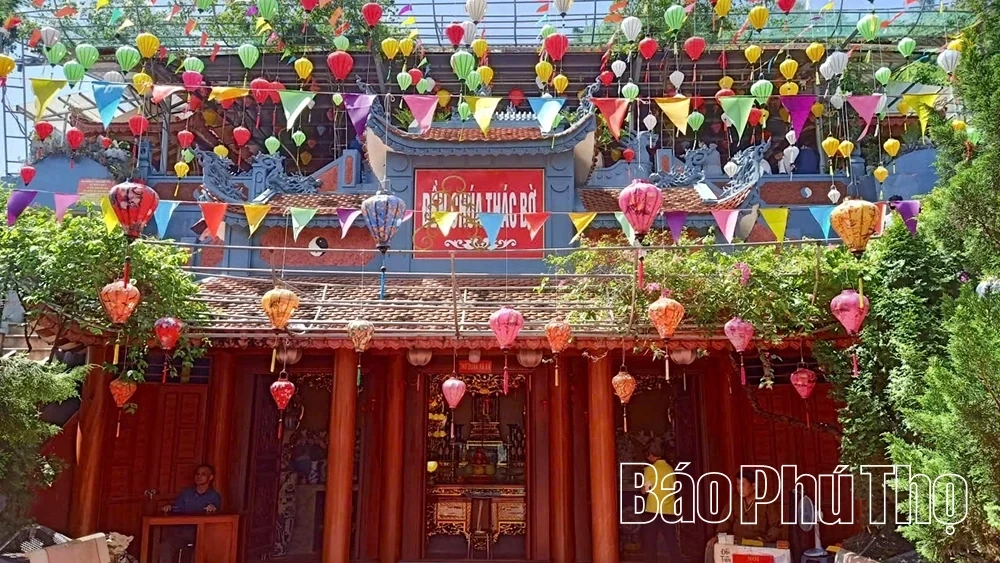
The Thac Bo Goddess Temple located in Thung Nai Commune.
According to historical chronicles, between 1430 and 1432, King Le Loi, ruling under the era name Thuan Thien, led his imperial forces to suppress the rebellion of Deo Cat Han in Muong Le (Son La province). As the troops marched upon the Thac Bo whirlpools, they were confronted by violent, churning currents and jagged rock formations that sent white froth shooting into the sky, completely freezing the army’s advance.
In that hour of crisis, a Muong ethnic woman named Dinh Thi Van from Hao Trang Commune, alongside an unnamed Dao ethnic woman, courageously rallied local youths to harvest timber and carve dugout canoes. They mobilized the citizenry to construct bamboo rafts and donate vital food reserves, successfully reinforcing the soldiers and enabling the entire army to clear the Thac Bo rapids to triumph over the enemy.
On his victorious return journey in March 1432 (the Year of the Water Monkey), King Le Loi rested his forces at Thac Bo. The monarch carved an epic poem directly into a cliff face, chronicling his campaign against Deo Cat Han and his crossing of the Long Thuy waters—a historic artifact revered today as the Le Loi Stele.
Following their passing, local lore maintains that the two women frequently manifested as protective spirits, guarding fishermen and traders navigating the dangerous rapids. Paying deep homage to their guardianship, the populace revered them as the Goddesses of Thac Bo. The Emperor subsequently issued an imperial decree commanding the local population to construct shrines in their honor. In 2008, the Thac Bo Temple complex was officially designated as a Provincial-Level Historical and Cultural Relic by the Hoa Binh Provincial People’s Committee.
The Mystic Grandeur of Thac Bo Cave: A Palace Inside the Mountain
In tandem with the sacred shrines, the spiritual tourism ecosystem of Thac Bo is globally renowned for Thac Bo Cave—arguably one of the most sublime caverns within the Hoa Binh Lake perimeter. Floating at an altitude of approximately 100 meters above the lake’s water level, the cavern was sculpted across millions of years of geological evolution, creating an otherworldly network of stalactites and stalagmites. These stone formations have been naturally carved into striking silhouettes of dragons, phoenixes, golden trees, silver branches, and soft lotus buds, leaving spelunkers and pilgrims completely spellbound.
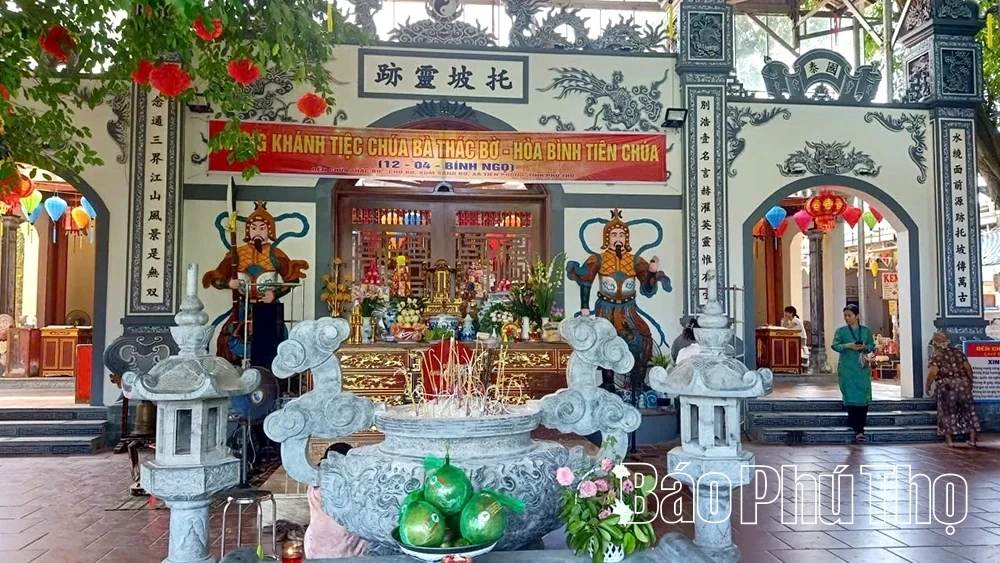
The Thac Bo Goddess Temple located in Tien Phong Commune.
Stepping into the heart of the cavern, visitors are instantly embraced by a refreshing, year-round cool breeze and a profoundly sacred atmosphere. Many travelers describe Thac Bo Cave as a majestic “palace inside the mountain,” where raw natural beauty intertwines with spiritual faith. This seamless cross-over between sacred worship and geological marvels drives the undeniable magnetism of Thac Bo tourism.
Mrs. Nguyen Thi Lan, a traveler arriving from Hanoi, shared: "Year after year, my family makes a pilgrimage to pay homage to the Thac Bo Goddess. Beyond praying for health and peace, we come here to seek total soul serenity. The natural scenery is incredibly immersive, evoking a deep sense of intimacy and sacredness."
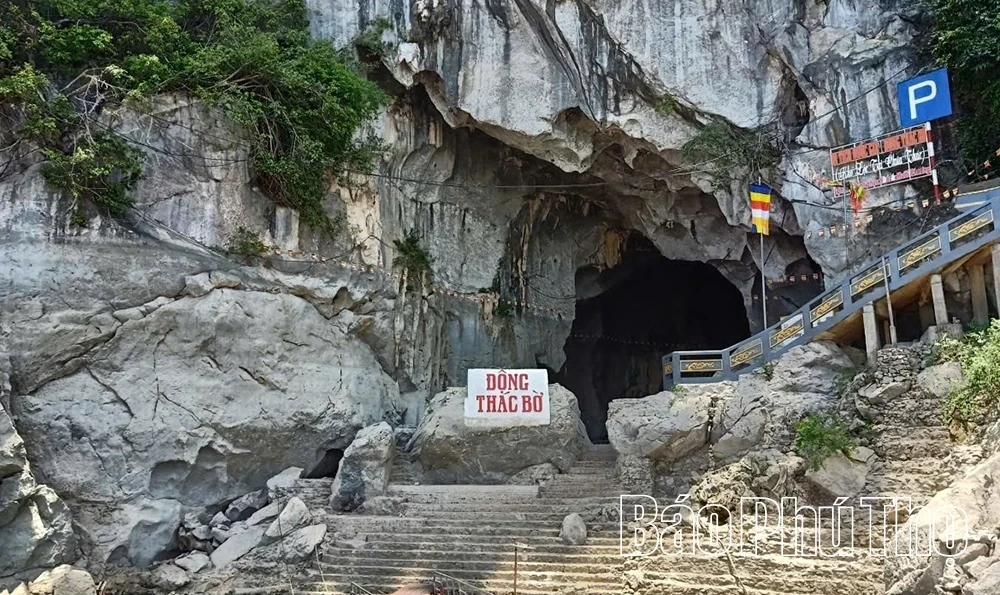
Thac Bo Cave is highly praised as a majestic “palace inside the mountain,” where raw natural beauty intertwines beautifully with spiritual faith.
Weaving Spiritual Pilgrimages into Sustainable Local Agribusiness
The physical space of the Thac Bo Goddess Temple exhibits a flawless harmony between pristine nature and sacred architecture. Travelers stepping foot onto these grounds routinely feel a deep sense of inner peace, leaving behind the chaotic anxieties of urban life.
Far more than a conventional pilgrimage site, the integrated Thac Bo Temple - Thac Bo Cave complex has transformed into a signature tourism brand of Hoa Binh Lake. Over recent years, regional transport networks, docking ports, and hospitality services have undergone continuous upgrades, creating a highly comfortable landscape for travelers. Itineraries combining temple worship with eco-explorations of Hoa Binh Lake and cultural immersions within the indigenous Muong and Dao ethnic hamlets have emerged as a highly sought-after travel package.
Annually, particularly from the dawn of Spring through the peak of the festival season (concluding in the fourth lunar month), tens of thousands of pilgrims cross the waves of Hoa Binh Lake to commune with these twin temples. This massive seasonal influx generates lucrative, green livelihoods for numerous households offering water transport services, homestays, local catering, community-based ecotourism, and marketing unique mountain specialties.
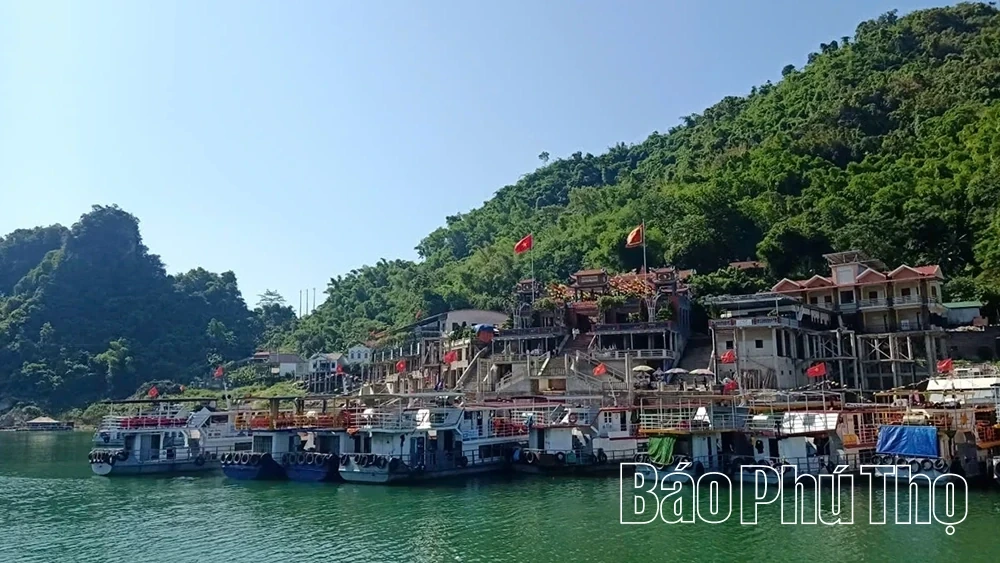
A convoy of tourist boats ferrying pilgrims from all horizons to pay homage at the Thac Bo Goddess Temple.
Mrs. Nguyen Thi Van, a local tourism service operator on Hoa Binh Lake, observed that visitor arrivals to the Thac Bo Goddess Temple have expanded on a highly stable curve year over year, peaking during the Lunar New Year season. “These vibrant tourism activities have unlocked meaningful jobs, elevated the income baseline for local families, and injected a powerful economic development impulse across our entire lakeside region,” Mrs. Vân concluded.
Dinh Thang

baophutho.vn For decades, the Hai Luu Stork Sanctuary (Hai Luu Commune, Phu Tho Province) has been widely recognized as a highly unique eco-tourism hotspot,...

baophutho.vn Rolling mountain chains, deep emerald old-growth forests, winding terraced rice paddies, and small hamlets nestled under pristine valleys form...

baophutho.vn In recent years, alongside the rigorous preservation and promotion of its distinctive cultural assets, Phu Tho's hospitality sector has been...

baophutho.vn Entering a new stage of development with an expanded regional connectivity framework, Phu Tho’s tourism sector recorded encouraging results...

The artisans keeping Muong culture alive

baophutho.vn "Transitioning tea cultivation toward organic standards and upscaling product quality to drive green tourism, while systematically expanding...

baophutho.vn During the first six months of 2026, Phu Tho Province’s tourism sector recorded positive results thanks to a series of effective tourism...

Traditional identity in modern life

baophutho.vn “Transforming tea production toward organic cultivation, improving product quality, promoting green tourism, and gradually bringing Long Coc...

baophutho.vn Amidst the vibrant, bustling rhythm of Vinh Phuc Ward, Dam Vac emerges as a precious green jewel, offering an invigorating ecological sanctuary...
Editor-in-chief: Vi Manh Hung
License No.154/GP-BTTTT dated March 3,2022 by the Ministry of Information and Communications.
Address : No.Nguyen Tat Thanh street, Viet Tri ward, Phu Tho province
Tel: (0210) 3846.508; (0210) 3855.303
Email: info@baophutho.vn
Website: baophutho.vn
Copyrights Phu Tho Newspaper; All rights reserved
