
{title}
{publish}
{head}

Steadfast in its goal of not trading the environment for economic growth, Phu Tho province is applying strict green standards to incoming investment flows. Tightening input screening, prioritizing clean technology, and innovating management methods for industrial parks and clusters serve as key solutions for the province to realize its goal of sustainable growth, harmonizing production development with ecosystem protection.
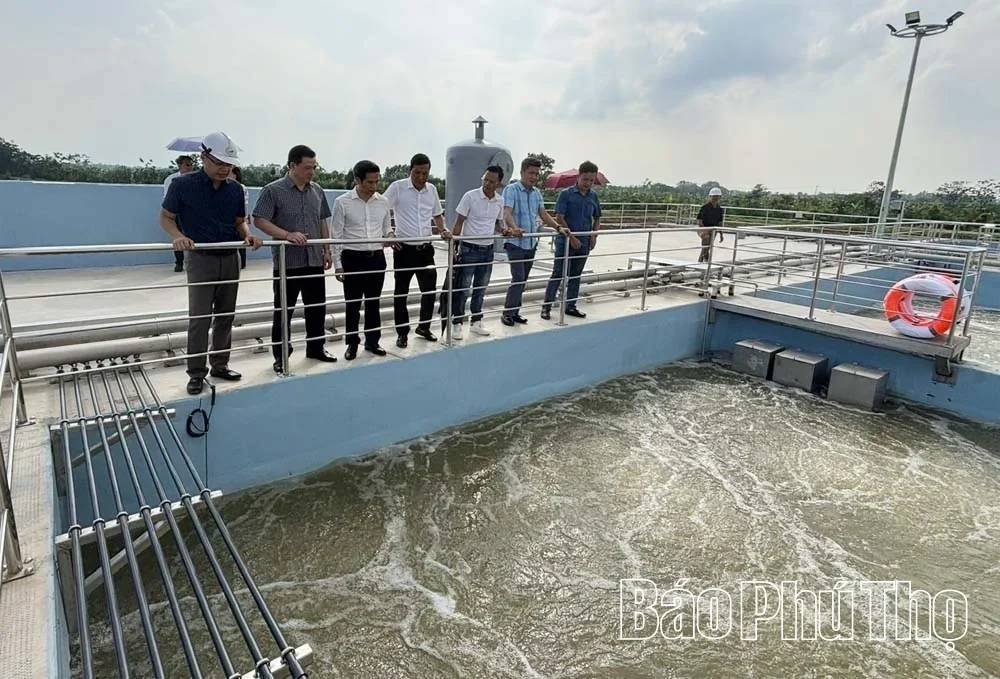
High-tech wastewater treatment system at Nam Binh Xuyen Green Park Industrial Zone.
Phu Tho is rising to become a dynamic industrial “pole” at the gateway northwest of the Capital. With 31 established industrial parks (IPs), the province is step-by-step forming a large-scale, modern industrial ecosystem that generates new momentum for economic growth. Among these, 18 IPs have entered into operation, attracting 880 domestic and foreign projects. Notably, foreign capital flows hold the upper hand with 528 FDI projects totaling over 11.2 billion USD in registered capital. To date, approximately 81.5% of these projects have officially operated, making substantial contributions to GRDP growth, export turnover, budget revenue, and creating stable employment for tens of thousands of workers.
However, the high concentration of sectors such as mechanical engineering, electronics, garments, and building materials also confronts the industrial ecosystem with considerable challenges—especially regarding the environment, infrastructure, and sustainable development requirements. According to statistics from the Provincial Industrial Zones Management Board, in 2025, IPs across the province generated approximately 1.72 million tons of municipal solid waste, around 243,000 tons of industrial solid waste, and nearly 68,000 tons of hazardous waste. Pressure further escalates as factories discharge roughly 44,970 cubic meters of wastewater alongside massive volumes of industrial emissions every day and night. Without methodical and strict environmental protection solutions, these waste volumes could easily cause severe pollution, directly threatening local residents' lives and the province’s sustainable growth.
Clearly identifying these risks, the province proactively took a step ahead in constructing technical infrastructure systems for environmental protection. To date, almost all operating IPs have received synchronized investment in rainwater separation systems, wastewater collection, and strict solid waste storage areas. Notably, 15 out of 18 IPs have put centralized wastewater treatment plants into operation, raising the wastewater discharge connection rate of secondary projects to 95%. Waste source control has also been digitized, as most IPs have completed the installation of automatic monitoring systems that continuously transmit data to management agencies for strict discharge supervision.
Environmental law compliance awareness among business owners and workers has been increasingly elevated through practical, visual publicity and training activities—contributing to limiting violations and minimizing complaints or petitions related to the environment. In addition, linkage chains between IPs and professional waste treatment entities—such as Phu Ha Environment Co., Ltd., Nhat Tan, Binh Xuyen, and Cong Nghiep Xanh—have forged a synchronized collection, sorting, and recycling network for industrial waste, turning one factory’s waste into input materials for another manufacturing sector.
Despite achieving positive results, environmental management in IPs still faces barriers due to thin specialized staffing, limited budgetary resources, and instances where a small number of enterprises arbitrarily raise production capacity without completing legal procedures. This reality demands a strategic shift: proactively controlling risks right from project reception, rather than struggling to handle end-of-pipe incidents.
In the context where ESG (Environmental - Social - Governance) standards have become mandatory “rules of the game” in global supply chains, Phu Tho identifies green industry as the “passport” to attract high-quality capital flows. Accordingly, the province is tightening initial screening processes, prioritizing modern, energy-saving, and closed-loop technology projects. At the same time, it is accelerating administrative reform and perfecting decentralization mechanisms to process environmental procedures under a “one-stop, on-site” model—both reducing costs for investors and enhancing supervisory efficacy. Alongside this, financial resources are being optimized and specialized capacity elevated to increase the frequency of unannounced inspections and sampling.
Consensus in strictly executing environmental impact assessments and protection commitments between local authorities and enterprises serves as the “golden key” for Phu Tho to make economic breakthroughs, affirming its position as a modern, green, and sustainably developed industrial center.
Tran Tinh

baophutho.vn On the morning of September 11, the People's Committee of Quang Yen Commune organized a Groundbreaking Ceremony for the technical...

baophutho.vn Phu Tho aims to become a hub for receiving high-tech FDI, green industry, and tech services for the Northwest region and the Capital's Western...

baophutho.vn Within the framework of the official visit and working trip to South Korea by a high-ranking Vietnamese delegation, Mr. Tran Duy Dong—Alternate...

baophutho.vn Within the framework of the official visit to South Korea by National Assembly Chairman Tran Thanh Man and a high-ranking Vietnamese...

baophutho.vn The pungent kick of cham cheo (traditional dipping spice), the deep smoky flavor infused in each strip of dried meat, the sweetness of forest...

baophutho.vn In the 8 months of 2026, total state budget revenue in the province reached 41.6 trillion VND, an increase of 12.8% over the same period last...

baophutho.vn Investment attraction in industrial parks (IPs) across Phu Tho Province continued to post positive results in August and the first eight months...

baophutho.vn Alongside the growing attraction of industrial zones (IZs), environmental protection requirements are placed at the top priority by Phu Tho...

baophutho.vn Along with existing industrial zones, clusters, and business systems, following the merger, Phu Tho Province has gained additional room to...

baophutho.vn Amid an environment filled with challenges, various levels and sectors in Phu Tho province are decisively implementing synchronized solutions...
Editor-in-chief: Vi Manh Hung
License No.154/GP-BTTTT dated March 3,2022 by the Ministry of Information and Communications.
Address : No.Nguyen Tat Thanh street, Viet Tri ward, Phu Tho province
Tel: (0210) 3846.508; (0210) 3855.303
Email: info@baophutho.vn
Website: baophutho.vn
Copyrights Phu Tho Newspaper; All rights reserved
