
{title}
{publish}
{head}

Facing the majestic Ba Vi mountain range across the Da River, Dam Gai Lake (Lac Song zone, Yen Son commune) emerges like a landscape painting amidst the vast wilderness. The clear blue water reflects the sky and clouds, while small lush green islands rise in the heart of the lake, creating a scene that is both grand and peacefully romantic. Few know that more than six decades ago, when deciding to cut through hills and dam the Dai Stream, the mountainous farmers of that era not only created an irrigation work for agricultural production but also unwittingly left behind a precious “green gem” in the deep forest for present generations.
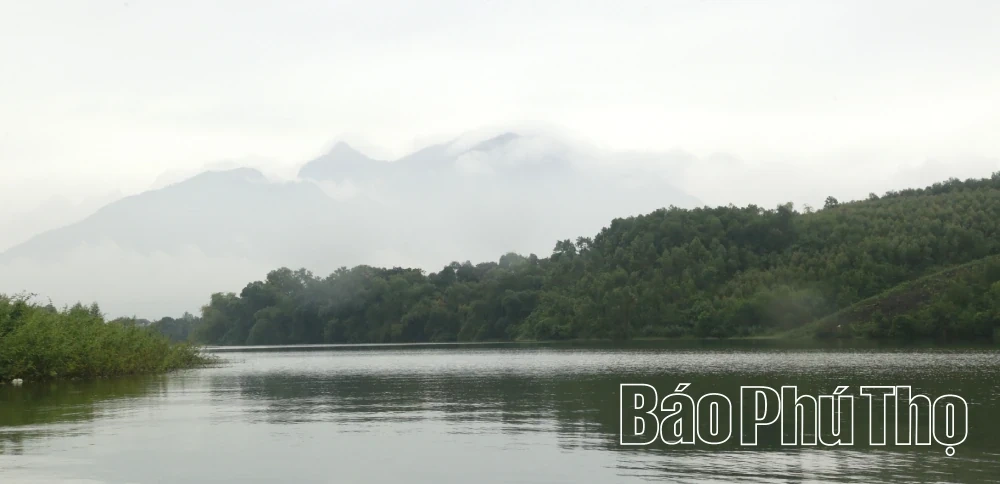
Facing the Ba Vi mountain range, Dam Gai Lake is as beautiful as a landscape painting.
Dam Gai Lake is not a gift from nature, but the result of human labor. According to village elders, since the Muong ethnic community first came here to clear land and settle down, their lives mainly relied on the forest and the fields along the river. The water source for farming depended solely on the Dai Stream originating from Cao and Heo hills. In years with favorable weather, the rice crops thrived and provided enough food; in years with droughts or erratic floods, crop failures and hunger followed. Floodwaters from upstream repeatedly washed down rocks, soil, and trees, burying fields and requiring immense effort from local residents to restore production.
Unwilling to resign themselves to “relying on heaven and earth,” in the early 1960s, local party committees and authorities mobilized the people to unite in damming the stream to build a reservoir, determined to “squeeze water from the earth and command rain from the sky.” Thousands of working days, picks, shovels, and bare shoulders built two dams nearly 400 meters long, opening up a stable water storage area in the middle of the mountains and forests.
The completed project brought a sustainable irrigation source to downstream fields, helping mitigate floods, increase crop yields, and gradually improve local livelihoods. More than ten years later, as the earthen dam gradually degraded, the State invested further to build a solid structure, ensuring long-term effectiveness.
Even more precious is that Dam Gai Lake retains not only a water source, but also the memory of a period when the entire community united to transform nature. Today’s serene water surface was exchanged for the sweat and arduous efforts of previous generations. That very historical value makes Dam Gai Lake a cherished part of the region’s collective memory. During difficult years, the lake was also a valuable food source sustaining many families. Mr. Nguyen Xuan Bo, former Party Cell Secretary and Head of Lac Song zone, recalled: “My house was right by the lake, so catching fish was almost a daily task for my entire family. Because there were many tree stumps and large boulders at the bottom of the lake, net fishing was very difficult, so we mostly used fishing rods or fish traps along the shore. Even so, fish and shrimp were abundant; with a bit of hard work, we could improve our daily meals. I even witnessed people catching fish weighing up to 40 to 50 kilograms...”
Fresh water and a rich natural ecosystem have created specialties with the unique flavor of Dam Gai, once famous throughout the region.
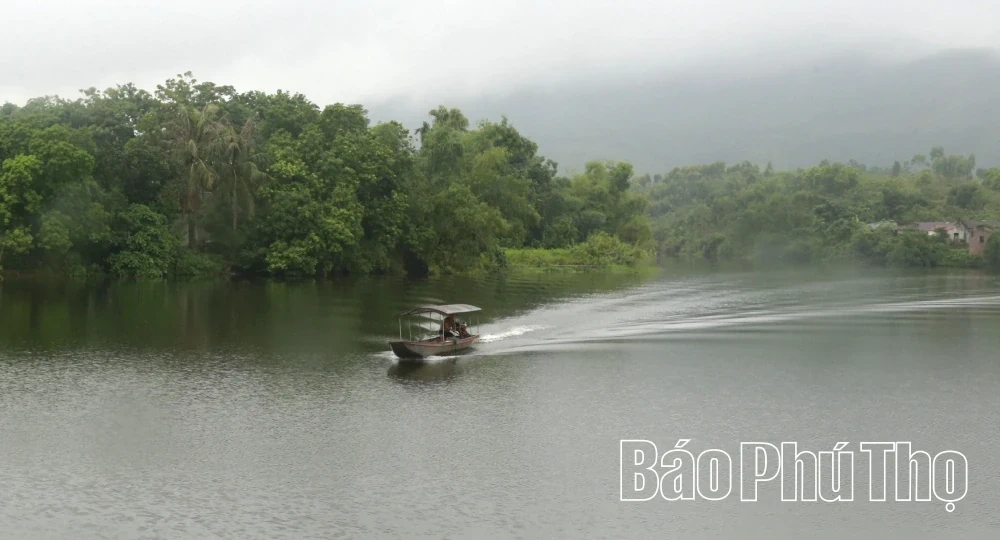
With its grand, peaceful, and romantic scenery, Dam Gai Lake holds great potential for eco-tourism and resort development.
With a water surface area of about 36 hectares—expanding to nearly 50 hectares during the rainy season—Dam Gai Lake possesses a rare landscape. Twenty-four water branches meander through lush green hills, alongside a floating island of about 10 hectares as well as several dry and submerged islets, creating a harmonious landscape of mountains and waters. Local residents fondly refer to this place as “Cat Ba in the mountains.” Though the comparison is simple and stems from love and pride for their homeland, anyone who has ever set foot here can hardly deny the untouched beauty of the lake area.
However, that beauty remains known to few; even many residents in the commune have never once toured the entire lake by boat. Mr. Nguyen Van Tung, Head of Lac Song zone, shared: Since the early 1990s, the lake’s water surface was leased to a business for aquaculture. Currently, fisheries exploitation continues regularly, but economic efficiency is largely limited to the business’s fish farming, while potential for eco-tourism and resorts remains virtually untapped.
Reality shows that resources only truly become assets when harvested properly and tied to community benefits. With its pristine natural landscape, diverse ecosystem, and favorable location, Dam Gai Lake could fully become an attractive destination for eco-tourism along the Da River region if methodically planned and invested in. Discussing directions to leverage local values and awaken potential, Mr. Dinh Van Tinh, Vice Chairman of the Yen Son Commune People’s Committee, stated: Maximizing existing potential and advantages is a consistent direction in local socio-economic development. Alongside agriculture, the commune has identified commerce, services, and tourism as sectors that will drive breakthroughs in the coming period. Dam Gai Lake has also drawn interest from investors researching the development of resorts and golf courses. If these plans materialize, the area will gain further momentum to develop, contributing to improving people’s lives and giving a new look to this mountainous region.
More than sixty years ago, mountainous farmers cut through mountains and built dams to hold water for their fields. They could not have imagined that they were leaving behind a special scenic landscape amidst the wilderness for today’s generation. What Dam Gai Lake lacks now is not natural beauty, but a suitable path for this “green gem” to be awakened and shine, becoming a sustainable livelihood for local people and a new highlight on the tourism map of the Ancestral Land.
Cam Ninh

baophutho.vn On July 18, the Party Committee, People's Council, People's Committee, and Vietnam Fatherland Front Committee of Tam Dao commune organized a...

baophutho.vn In its new phase of development following the provincial merger, Phu Tho is steadily establishing itself as a destination where historical...

baophutho.vn As the summer sun casts its golden glow over the midland hills of the Ancestral Land, the lotus lake at Vuon Vua Resort & Villas in Tu Vu...

Tay culture in modern life

baophutho.vn With a target of welcoming 15 million visitors and generating VND 16.3 trillion in tourism revenue in 2026, Phu Tho Province is actively...

baophutho.vn Majestic, untouched natural landscapes paired with the unique cultural identities of ethnic minority communities have created a distinct appeal...

baophutho.vn Starting as a high-tech cordyceps mushroom producer, Tam Dao Mushroom Cooperative is gradually developing a multi-value agricultural model in...

Preserving Muong folk song

baophutho.vn Integrating products under Vietnam's One Commune One Product (OCOP) Program with tourism has become a key development strategy in Phu Tho...

baophutho.vn For generations, the Lo River has been not only a natural flow but also a current of history, culture, and life. For the people of Phu Tho, the...
Editor-in-chief: Vi Manh Hung
License No.154/GP-BTTTT dated March 3,2022 by the Ministry of Information and Communications.
Address : No.Nguyen Tat Thanh street, Viet Tri ward, Phu Tho province
Tel: (0210) 3846.508; (0210) 3855.303
Email: info@baophutho.vn
Website: baophutho.vn
Copyrights Phu Tho Newspaper; All rights reserved
