
{title}
{publish}
{head}

Following the expansion of its development space, Phu Tho possesses a rare “tourism map,” where cultural heritage, ecological landscapes, and ethnic identity converge. From winding roads connecting tea hills, primary forests, lakes, and local villages, opportunities to forge green tourism itineraries are opening up. However, to keep tourists staying longer, each destination must be linked through products that boast distinct identities and unique experiences.
Along the Green Trails
During a weekend getaway at Long Coc Ecolodge, Ms. Le Thu Hang, a tourist from Hanoi, was particularly impressed by the fresh atmosphere, bowl-shaped tea hills shrouded in clouds, and the warm hospitality of the locals. For her and her group, watching the sunrise over the tea hills was a truly memorable experience. What captivated them was not just chasing clouds or taking beautiful photos, but the feeling of slowing down amidst nature, remaining close to the people and the rhythm of local life.
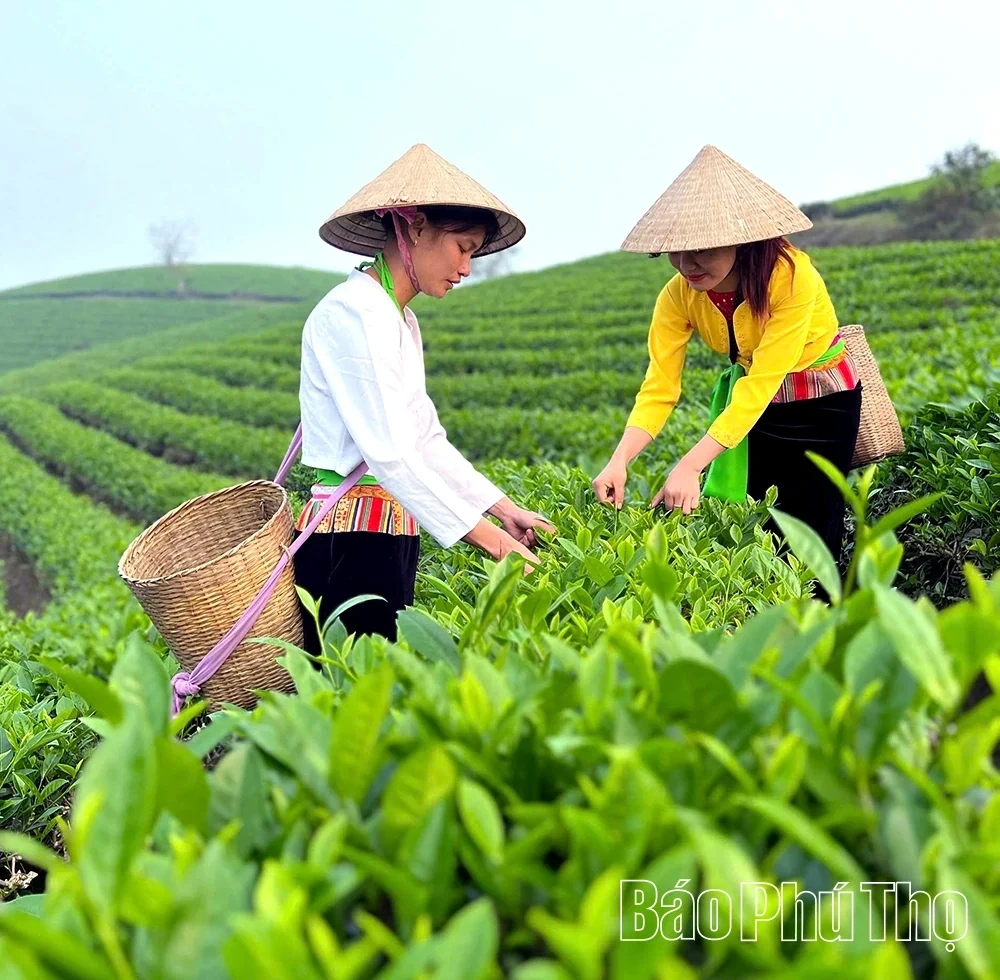
The experience of picking tea leaves on the lush green tea hills in Long Coc contributes to creating a highlight for local agricultural tourism products.
Transforming from an agricultural tea-production zone, Long Coc is step-by-step becoming an experiential destination. Each year, the “cloud-chasing” season attracts about 3,000 to 4,000 visitors, and the entire commune now operates 6 homestays. From the tea hills, tourists can continue their journey to Xuan Son National Park to trek through the forest, explore caves, savor rock crabs, multi-spurred roosters, sweet leaves, stream fish, and stay at local community homestays.
Xuan Dai commune currently has 11 accommodation facilities capable of serving around 800 visitors. Though small in scale, the connection between Long Coc and Xuan Son has initially formed a seamless journey spanning agricultural landscapes, forest ecology, and community-based cultural experiences.
The story of Long Coc and Xuan Son demonstrates that resources only generate true value when transformed into products and integrated into deep, meaningful itineraries. Following the expansion of its development space, the province not only gained more destinations but also created conditions to connect previously isolated tourism types: from the Ancestral Land rich in history and spirituality to Tam Dao and Xuan Son with their lush, deep forests; from Thanh Thuy and Kim Boi with hot thermal mineral springs to Lake Hoa Binh and Mai Chau rich in community culture. Each destination is a distinct color that, when arranged in a unified itinerary, adds stopover points, broadens experiences, and enhances visitor retention.
The foundation for these journeys lies in a rich resource system. The entire province currently features 2 national tourist areas—Hung Kings Temple and Tam Dao; the Mai Chau tourist area alongside 15 recognized provincial-level tourist spots. Documentation is currently being finalized for Lake Hoa Binh to achieve national tourist area status. Thousands of historical and cultural relics, nearly 2,000 intangible cultural heritage items, and 5 UNESCO-inscribed heritages create rare historical depth, enabling the simultaneous development of spiritual, heritage, eco, resort, and local culture tourism.
Increasing Value on Every Journey
The synergy of this new space is translating into impressive growth figures. In the 2021–2025 period, the province welcomed over 54.08 million visitors, including nearly 2.34 million international tourists, with total staying visitors reaching 16.8 million; estimated tourism revenue exceeded 55.1 trillion VND. Visitor numbers increased by an average of 22.9% annually, while revenue grew by 26.3% per year. The province currently houses 1,520 accommodation establishments with more than 20,000 rooms, 9 four-to-five-star hotels, and 94 active travel agencies.
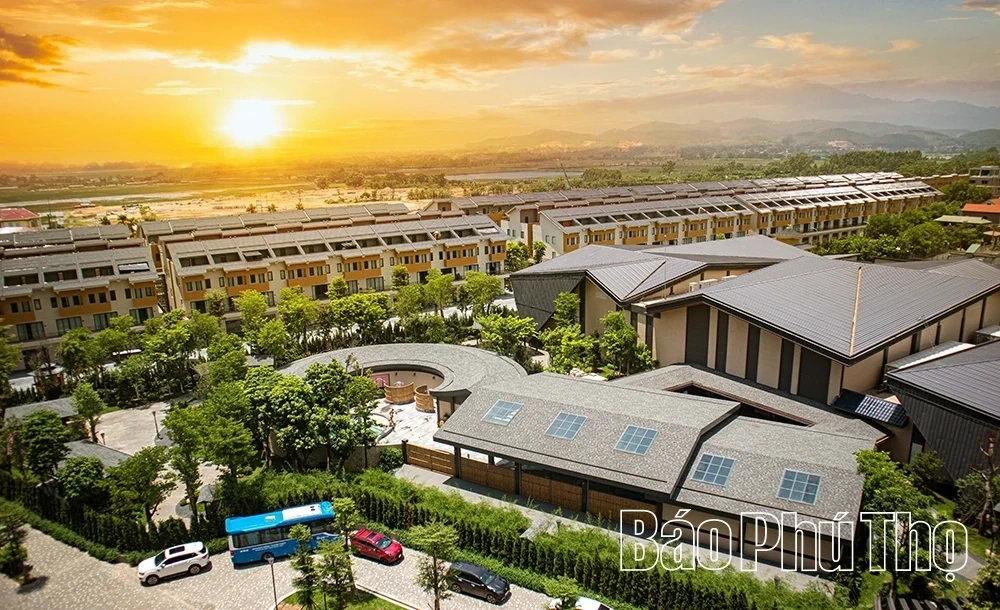
Wyndham Lynn Times Thanh Thuy hot mineral resort space contributes to enriching the province's tourism products.
These figures demonstrate the destination’s growing appeal, yet they also raise questions about the value generated per journey. Passing through multiple spots does not equate to staying longer, and an increase in visitor volume does not guarantee a proportional rise in spending. Although the province’s tourism offerings are diverse, distinct signatures remain somewhat understated. Auxiliary services remain fragmented and lack strong appeal. International visitors account for only about 4.3% of total arrivals, while promotional activities in key markets and digital technology applications have yet to make a major breakthrough.
This gap reveals that the goal of inter-regional connectivity goes beyond taking tourists through various sites—it must extend length of stay, broaden experiential demand, and boost expenditure. Several routes have begun connecting resource layers, such as Hung Kings Temple – Lai Len Shrine – Hung Lo Ancient Village; Hung Kings Temple – Hung Lo Ancient Village – Xuan Son National Park – Thanh Thuy Hot Mineral Resort; or Hung Kings Temple – Tay Thien – Thac Bo Temple. From a single pilgrimage, visitors can seamlessly explore forests, experience village culture, relax in thermal springs, or discover craft villages and regional specialties.
Mr. Dang Tuan Hung, Head of the Tourism Management Division under the Department of Culture, Sports, and Tourism, noted: “Natural and cultural resource advantages only truly realize their value when transformed into products with distinct identities that offer unique experiences to visitors. Moving forward, the tourism sector will continue to push for the development of green tourism, community tourism, and agricultural tourism linked with OCOP products. At the same time, we will accelerate digital transformation, enhance service quality, and strengthen linkages between destinations to extend lengths of stay, increase spending, and boost overall competitiveness.”
To materialize this vision, collaboration must go beyond designing tour routes. It requires coordination in spatial planning, investment attraction, promotion, human resource training, service standardization, and environmental protection. Digital technology can assist tourists in discovering, choosing, and booking services ahead of their trip; yet it is authentic, high-quality products and community involvement that ultimately give them a reason to stay and return.
As evening falls, the lake surface calms beneath the dark shadows of the mountains; in another corner, fog settles over the tea hills, and inside local hamlets, hearth fires warm the space beneath traditional stilt houses. These landscapes have endured for generations. What needs to be awakened is the connection between these values, ensuring that every trip is not merely a passing visit, but a deep journey into nature, culture, and the authentic rhythm of life. The path to green tourism is wide open. Its enduring appeal depends on how these unique values are preserved, connected, and transformed into profound experiences in the hearts of visitors.
Nguyen Yen

Discovering the ancient Dinh Chu communal house

baophutho.vn Facing the majestic Ba Vi mountain range across the Da River, Dam Gai Lake (Lac Song zone, Yen Son commune) emerges like a landscape painting...

baophutho.vn On July 18, the Party Committee, People's Council, People's Committee, and Vietnam Fatherland Front Committee of Tam Dao commune organized a...

baophutho.vn In its new phase of development following the provincial merger, Phu Tho is steadily establishing itself as a destination where historical...

baophutho.vn As the summer sun casts its golden glow over the midland hills of the Ancestral Land, the lotus lake at Vuon Vua Resort & Villas in Tu Vu...

Tay culture in modern life

baophutho.vn With a target of welcoming 15 million visitors and generating VND 16.3 trillion in tourism revenue in 2026, Phu Tho Province is actively...

baophutho.vn Majestic, untouched natural landscapes paired with the unique cultural identities of ethnic minority communities have created a distinct appeal...

baophutho.vn Starting as a high-tech cordyceps mushroom producer, Tam Dao Mushroom Cooperative is gradually developing a multi-value agricultural model in...

Preserving Muong folk song
Editor-in-chief: Vi Manh Hung
License No.154/GP-BTTTT dated March 3,2022 by the Ministry of Information and Communications.
Address : No.Nguyen Tat Thanh street, Viet Tri ward, Phu Tho province
Tel: (0210) 3846.508; (0210) 3855.303
Email: info@baophutho.vn
Website: baophutho.vn
Copyrights Phu Tho Newspaper; All rights reserved
