
{title}
{publish}
{head}

From small-scale production dependent on intermediaries, many cooperatives (co-ops) in Phu Tho have reorganized production areas, standardized production processes, invested in processing and expanded sales channels. This approach has helped increase product value and create more stable markets for agricultural products.
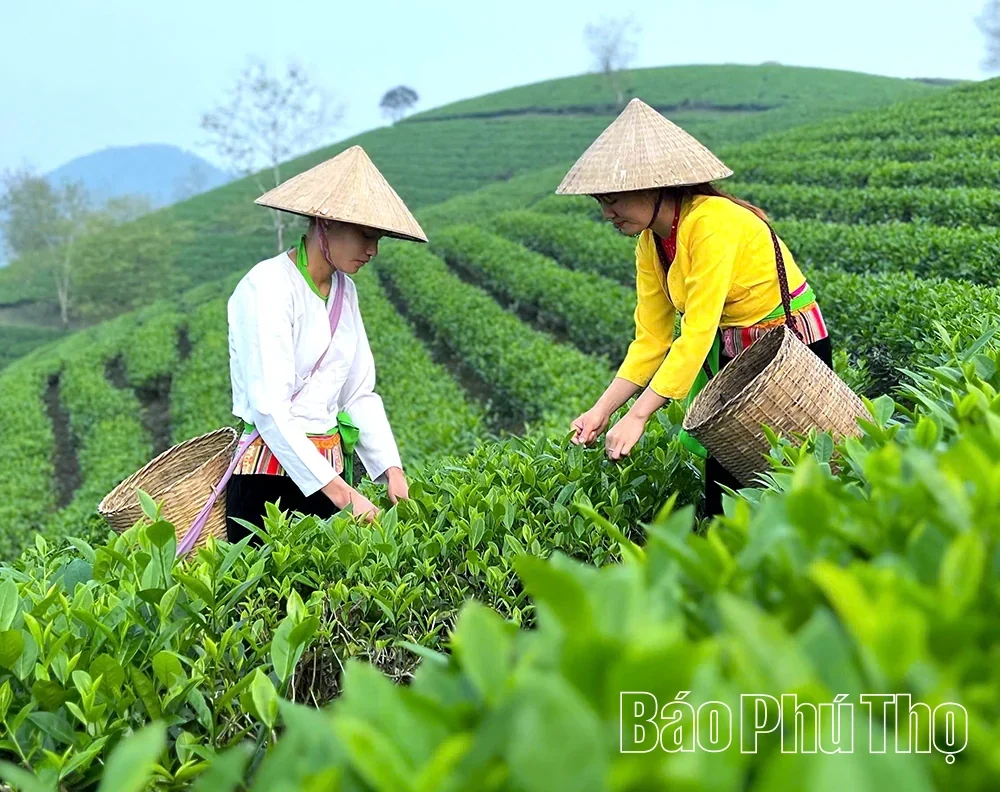
Members of the Long Coc Safe Tea Production Cooperative harvest tea in the cooperative’s raw material area.
Building Production Value Chains
Beyond simply supplying inputs and production services, many cooperatives have taken the lead in organizing raw material areas, providing technical guidance, controlling quality, processing products and connecting them with markets. As a result, farmers are no longer left on their own to “produce first and find buyers later.”
The Long Coc Safe Tea Production Cooperative is one example. Established in 2018, the cooperative currently has a linked raw material area of nearly 40 hectares, including 15 hectares meeting VietGAP standards, and supplies approximately 10 tonnes of finished tea annually. Standardized production processes, investment in processing, packaging and traceability labels have helped the cooperative develop four provincial-level OCOP products. In addition to traditional sales channels, its products are also introduced at the Long Coc tea hill tourist destination, where visitors can participate in sightseeing, experiential activities and tea tasting.
For the Tam Dao Mushroom Cooperative, growth has been driven by science and technology and digital transformation. Starting with oyster mushrooms and lingzhi mushrooms, the cooperative has developed more deeply processed products from cordyceps and established links with more than 130 households inside and outside the province, providing them with seedlings, technical support and product purchasing arrangements. Its website, social media channels and e-commerce platforms, together with supermarket chains and OCOP outlets, have helped expand the market.
As a result, the cooperative has secured a stable supply of raw materials while creating additional livelihoods for local residents, particularly in mountainous areas. Nguyen Quoc Huy, Director of the cooperative, said digital transformation has helped the cooperative sell products more effectively, connect with farmers and promote clean agricultural products. In 2025, the cooperative recorded revenue of more than 5 billion VND, with profits of approximately 2 billion VND.
Although they operate in different sectors and follow different development paths, both models demonstrate the coordinating role of cooperatives in production value chains. Farmers participate in organized processes with technical guidance and clearly defined markets rather than producing independently and then seeking buyers.
By the end of 2025, the province had 803 agricultural cooperatives, attracting approximately 129,300 members and providing regular employment for 20,600 workers. Average annual revenue per cooperative was estimated at 1.715 billion VND, with average profit of approximately 244 million VND. Among them, 135 cooperatives had established value-chain linkages with enterprises, while 127 cooperatives had applied high technology.
Opening the Way for Agricultural Products to Reach Wider Markets
To enter supermarkets and distribution chains or move toward export markets, agricultural products must meet increasingly stringent requirements for quality, food safety and traceability. Since 2021, many cooperatives in the province have received support to apply VietGAP, GlobalGAP and organic production standards, as well as establish growing-area codes.
In the former Hoa Binh area, 37 cooperatives received support for consulting and quality certification, while 43 cooperatives and cooperative groups received assistance in completing product standards. Authorities have issued 21 growing-area codes for export markets and 23 growing-area codes for domestic markets.
Alongside standardizing raw material areas, cooperatives have gradually invested in processing and preservation. In the former Hoa Binh area, 26 cooperatives received more than 25 billion VND in support to build factories, processing lines, cold storage facilities and collection points. Cooperatives in the former Phu Tho and Vinh Phuc areas received support for greenhouses, irrigation systems and preliminary processing and packaging equipment, helping reduce pressure to sell agricultural products during peak harvest periods and extend their supply periods.
Product branding and recognition have also received increasing attention. The province currently has approximately 700 OCOP products, including six 5-star products and more than 100 4-star products. During 2021–2025, more than 16.1 billion VND was allocated to support 31 cooperatives in standardizing quality, improving packaging and labeling, and upgrading product classifications.
According to Tran Van Tu, Chairman of the Provincial Cooperative Alliance, over the past five years, 889 cooperative instances received trade-promotion support totaling more than 22 billion VND, while 17 cooperatives received assistance in establishing production and agricultural-product distribution linkages.
Through trade fairs, exhibitions, supply-demand connection programs and OCOP product promotion activities, cooperatives have had more opportunities to meet distribution businesses, understand the requirements of different sales channels and adjust their products accordingly.
These efforts have opened additional opportunities for exports. In 2025, the Dai Dong Agricultural Cooperative maintained more than 31 hectares of Dien pomelo with growing-area codes, producing approximately 800 tonnes, of which 35 tonnes were exported to the EU through a partnership with an enterprise.
In the first quarter of 2026, the province’s agricultural export turnover exceeded 347 billion VND. Tea, bamboo shoots, processed vegetables, oranges, pomelos, cinnamon and spices have reached markets in the EU, the UK, Japan, South Korea, the United States and the Middle East.
However, the proportion of cooperatives participating in value chains remains only about 16.8%, while the proportion applying high technology is approximately 15.8%. Limited access to capital, processing infrastructure, management personnel and stable markets remain major bottlenecks. Therefore, support policies should prioritize cooperatives with established raw material areas, feasible production plans and clear sales contracts.
By 2030, the province aims to have 155 agricultural cooperatives linked with enterprises and 145 cooperatives applying high technology, while average revenue and profit are expected to increase by 8–10% annually.
Once cooperatives have sufficient capacity to control quality, process products and ensure stable supply, they will become an important link in bringing Phu Tho’s agricultural products to wider domestic and international markets.
Nguyen Yen

baophutho.vn From production and business to governance, the digital economy is becoming increasingly present in Phu Tho's economic life. Digital...

baophutho.vn Beyond mere disbursement figures, public investment is expected by Phu Tho to become a key driving force in perfecting infrastructure,...

baophutho.vn Leveraging advantages in soil conditions, climate, and production experience, over 500 hectares of tea and nearly 800 hectares of pomelos are...

baophutho.vn Within the framework of a working trip to Yunnan Province (China), on September 15, a working delegation from Phu Tho Province led by Mr. Vu...

baophutho.vn As of the end of August 2026, Phu Tho province disbursed nearly 10,000 billion VND in public investment capital, reaching 36.1% of the total...

baophutho.vn Phu Tho province is facing the requirement to not only maintain double-digit growth rates in 2026, but more importantly, to build strong enough...

baophutho.vn Steadfast in its goal of not trading the environment for economic growth, Phu Tho province is applying strict green standards to incoming...

baophutho.vn On the morning of September 11, the People's Committee of Quang Yen Commune organized a Groundbreaking Ceremony for the technical...

baophutho.vn Phu Tho aims to become a hub for receiving high-tech FDI, green industry, and tech services for the Northwest region and the Capital's Western...

baophutho.vn Within the framework of the official visit and working trip to South Korea by a high-ranking Vietnamese delegation, Mr. Tran Duy Dong—Alternate...
Editor-in-chief: Vi Manh Hung
License No.154/GP-BTTTT dated March 3,2022 by the Ministry of Information and Communications.
Address : No.Nguyen Tat Thanh street, Viet Tri ward, Phu Tho province
Tel: (0210) 3846.508; (0210) 3855.303
Email: info@baophutho.vn
Website: baophutho.vn
Copyrights Phu Tho Newspaper; All rights reserved
