
{title}
{publish}
{head}

Nestled in the lush green valley of Thung Nai Commune, Mo Hamlet appears like a rustic painting, where traditional stilt houses rest beside terraced fields and a gentle stream winding through the landscape. In early 2025, the Muong community-based tourism site here was officially recognized as a provincial 4-star OCOP destination, marking a new milestone in the journey to preserve and promote local cultural heritage.
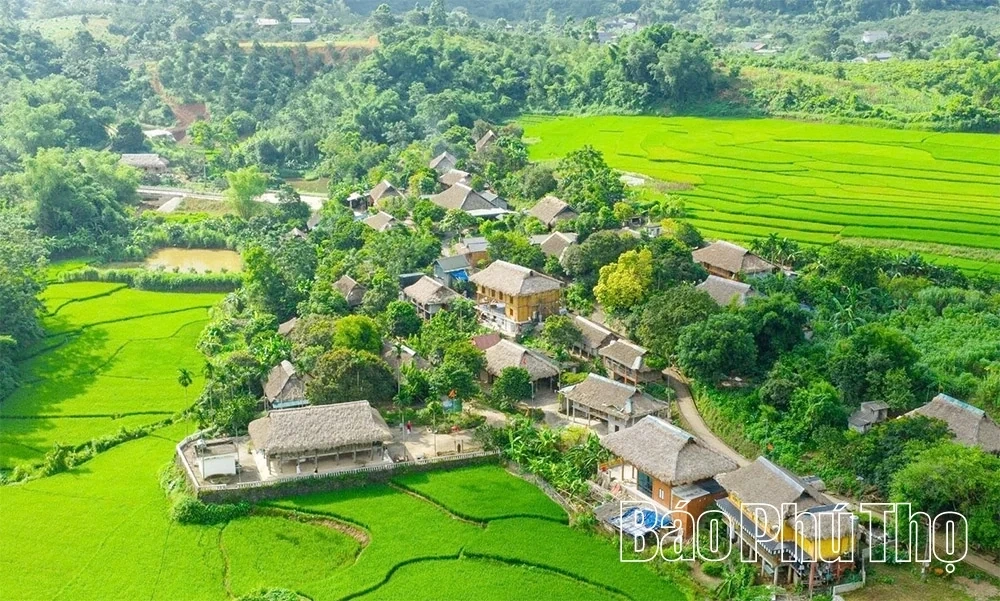
What defines the soul of Mo Hamlet is its traditional stilt houses — a cultural emblem of the Muong people. These houses not only reflect distinctive architectural craftsmanship but also embody the spiritual life of the local community. Typically built with their backs against hillsides to welcome cool breezes and avoid humidity, Muong stilt houses feature three functional levels: the upper floor for storing food, the middle floor for daily living and receiving guests, and the lower floor — once used to house livestock — now renovated into clean, comfortable communal spaces for tourists.
According to the village head Dinh Van Dan, Mo Hamlet has welcomed visitors since the 1980s, making it one of the earliest community tourism sites in the southern region of the province.
A major turning point came when the hamlet was officially rated under the “One Commune, One Product” (OCOP) Program for the 2023–2025 period. In early 2025, the area was recognized as a 4-star provincial OCOP community tourism destination — the result of continuous efforts by local authorities, residents, and the Mo Hamlet Community Tourism Cooperative.
Founded in 2021 with 30 members (14 of whom now meet standards for providing overnight accommodation), the cooperative has become a pioneering model supporting sustainable tourism development. Alongside this, the hamlet’s art troupe — with many members dedicated to teaching traditional Muong folk songs and dances — plays a vital role in preserving heritage and creating unique tourism offerings. Thanks to ongoing professionalization, Mo Hamlet welcomes tens of thousands of domestic and international visitors each year.
Visitors to Mo Hamlet can stroll along winding village paths, take photos beside terraced fields, explore orange, pomelo, and banana farms, or immerse themselves in daily agricultural activities with local residents: weaving fabric, harvesting rice, gathering corn, or catching stream fish. Homestays provide essential amenities, clean communal sleeping areas, hot water, and proper sanitation facilities. Local cuisine is diverse and flavorful, featuring specialties such as grilled pork wrapped in pomelo leaves, bitter bamboo shoots, free-range chicken, and ruou can. Together, these elements create a vibrant and authentic highland tourism experience.
Hong Trung

baophutho.vn The Phu Tho Provincial People's Committee has issued Decision No. 2299/QD-UBND, approving the Phu Tho Tourism Development Plan for the...

baophutho.vn Amidst the drifting white clouds of Tam Dao, the Mau (Mother Goddess) Temple and Vang (Golden) Pagoda complex emerges as a tranquil spiritual...

baophutho.vn Following the expansion of its development space, Phu Tho possesses a rare "tourism map," where cultural heritage, ecological landscapes, and...

Discovering the ancient Dinh Chu communal house

baophutho.vn Facing the majestic Ba Vi mountain range across the Da River, Dam Gai Lake (Lac Song zone, Yen Son commune) emerges like a landscape painting...

baophutho.vn On July 18, the Party Committee, People's Council, People's Committee, and Vietnam Fatherland Front Committee of Tam Dao commune organized a...

baophutho.vn In its new phase of development following the provincial merger, Phu Tho is steadily establishing itself as a destination where historical...

baophutho.vn As the summer sun casts its golden glow over the midland hills of the Ancestral Land, the lotus lake at Vuon Vua Resort & Villas in Tu Vu...

Tay culture in modern life

baophutho.vn With a target of welcoming 15 million visitors and generating VND 16.3 trillion in tourism revenue in 2026, Phu Tho Province is actively...
Editor-in-chief: Vi Manh Hung
License No.154/GP-BTTTT dated March 3,2022 by the Ministry of Information and Communications.
Address : No.Nguyen Tat Thanh street, Viet Tri ward, Phu Tho province
Tel: (0210) 3846.508; (0210) 3855.303
Email: info@baophutho.vn
Website: baophutho.vn
Copyrights Phu Tho Newspaper; All rights reserved
