

{title}
{publish}
{head}

Following the Lunar New Year, the tea-growing regions of Phu Tho have officially entered the Spring 2026 harvest—a season often referred to as the “Golden Season” by the farmers of the Ancestral Land.
More than just the first harvest of the year, Spring tea is a decisive factor in the quality, commercial value, and brand reputation of each region. The flavors of the early year are a crystallization of heaven, earth, and human labor, marking the start of a new production cycle filled with high expectations.
Residents of Cu Dong commune harvesting Spring tea.
This year, the harvest arrived earlier than usual due to warm temperatures and a leap year on the lunar calendar. Typically, the Spring tea season lasts only about two weeks—from late February to mid-March. Though brief, this window dictates the success of the entire production year.
Dong Luong commune currently boasts nearly 200 hectares of tea, including two products certified as 4-star OCOP (One Commune, One Product). Mr. Nguyen Van Thanh, Director of the Da Hen Tea Cooperative, shared: To prepare for a successful Spring crop, farmers pruned the canopies and meticulously fertilized the soil before the plants entered "hibernation."
"With hand-picking, each hectare yields about 200–300kg of fresh leaves, equivalent to 40–50kg of dried tea. Machine-picking can reach up to 1 ton of fresh leaves per hectare, yielding over 200kg of dried tea. However, hand-picked tea is usually a specialty grade and fetches a higher price," Thanh explained.
The processing of Spring tea is also more rigorous. Leaves are usually plucked in the early morning while dew still clings to them. They are then immediately fired (roasted) directly, bypassing the wilting stage required for other harvests. The tea master must calibrate temperature and timing with extreme care to preserve the natural fragrance and sweetness. Just a fraction too much heat can cause the “Spring essence” of the batch to vanish.
According to local farmers, while the yield of the Spring crop is lower than the main harvest, the selling price is typically 20–30% higher.
If the Spring crop is the starting point, the brand is the long-term destination. In the midlands of Phu Tho, tea has long been a primary economic crop. The province currently has approximately 14,500 hectares of tea under harvest, with over 95% consisting of high-yield, high-quality varieties. Hybrid varieties like LDP1, LDP2, and PH1 primarily serve the export black tea market, while specialty varieties such as Kim Tuyen, Bat Van Tien, and Oolong are used for premium green tea. This diversity of varieties creates a rich raw material source that meets various domestic and international market segments.
Phu Tho now boasts nearly 100 OCOP tea products, highlighted by 20 4-star products and two 5-star products—figures that reflect a powerful shift in production mindset. With over 1,000 processing facilities, Phu Tho supplies hundreds of thousands of tons of black tea and hundreds of tons of green tea annually, providing significant income for the local population.
To elevate value, the province has focused on production zoning, increased promotion, and refined the legal framework for intellectual property, particularly the development of the “Phu Tho Tea” certification mark. Many localities, enterprises, and cooperatives have invested in technological innovation and production linkages to control quality from the field to the final product. The VietGAP production model has been expanded in suitable areas, creating a foundation for safe, traceable products.
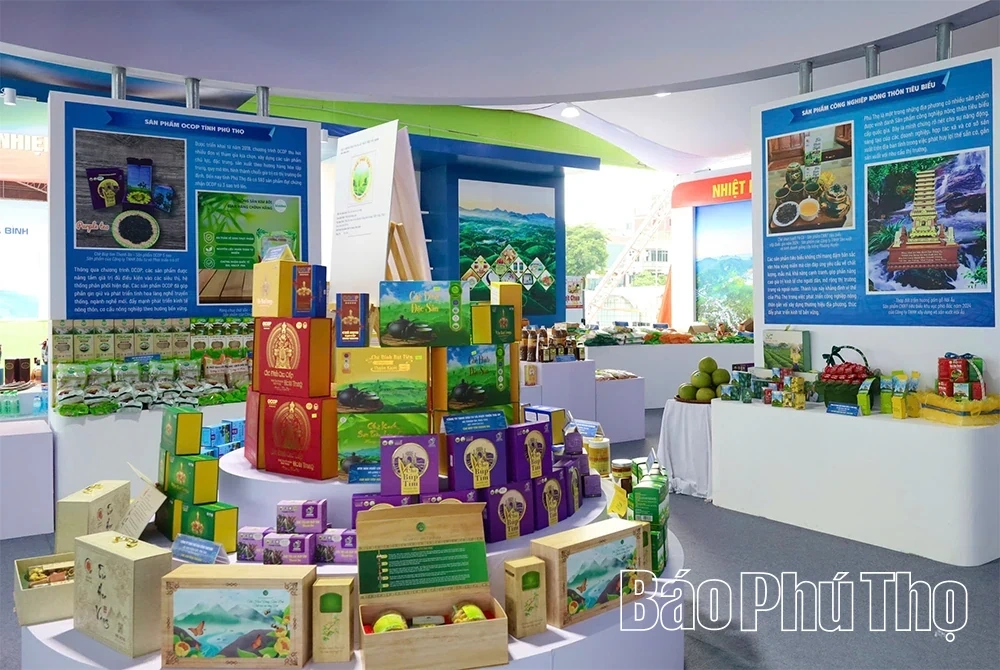
Phu Tho’s tea products are increasingly asserting their brand presence in the market.
Mr. Nguyen Thanh Hiep, Deputy Director of the Rural Development Department, noted: The fact that producers are proactively building and upgrading OCOP tea products shows a shift from focusing on quantity to prioritizing quality and market trends. To date, support policies continue to be implemented to encourage businesses and cooperatives to complete documentation, renew certifications, and invest in product upgrades.
Le Oanh

baophutho.vn On the morning of April 13, in Cu Dong Commune, Thanh Cong Construction and Investment Co., Ltd. held the groundbreaking ceremony for the Thang...

baophutho.vn According to the Department of Agriculture and Environment, for the 2021–2025 period, the province has focused on developing specialty pomelo...

baophutho.vn On the afternoon of April 10, the Provincial Industrial Zones Management Board held a ceremony to award the Investment Registration Certificate...

baophutho.vn On the afternoon of April 9, Mr. Vu Viet Van — Member of the Provincial Party Standing Committee and Vice Chairman of the Provincial People's...

baophutho.vn Identifying infrastructure development as a critical task, the province is focusing on decisive leadership to remove bottlenecks, shorten...

baophutho.vn In the first three months of the year, foreign direct investment (FDI) attraction in the province continued to record positive signals,...

baophutho.vn The impressive growth figures of Q1/2026 are creating positive psychological momentum for Phu Tho province. However, behind this bright picture...

baophutho.vn Digital transformation is no longer an option but an inevitable requirement across all sectors of life. For the collective economy and...

baophutho.vn Phu Tho province currently has a total of 140 approved Industrial Clusters (ICs). Among these, 130 ICs are planned across over 6,496 hectares,...

baophutho.vn On the afternoon of April 3, Prime Minister Pham Minh Chinh chaired the Q1/2026 online conference of the National Steering Committee on...
Editor-in-chief: Vi Manh Hung
License No.154/GP-BTTTT dated March 3,2022 by the Ministry of Information and Communications.
Address : No.Nguyen Tat Thanh street, Viet Tri ward, Phu Tho province
Tel: (0210) 3846.508; (0210) 3855.303
Email: info@baophutho.vn
Website: baophutho.vn
Copyrights Phu Tho Newspaper; All rights reserved
