
{title}
{publish}
{head}

Economic growth is always an important objective for every locality. However, in the context where traditional growth drivers gradually reveal their limits, alongside demands for green development, digital transformation, and increasingly deep international integration, the challenge set forth is not only growing fast, but growing through quality, productivity, science and technology, and innovation. For Phu Tho, this demand has become all the more urgent to effectively exploit new resources, creating a foundation to achieve two-digit growth targets in the new phase.
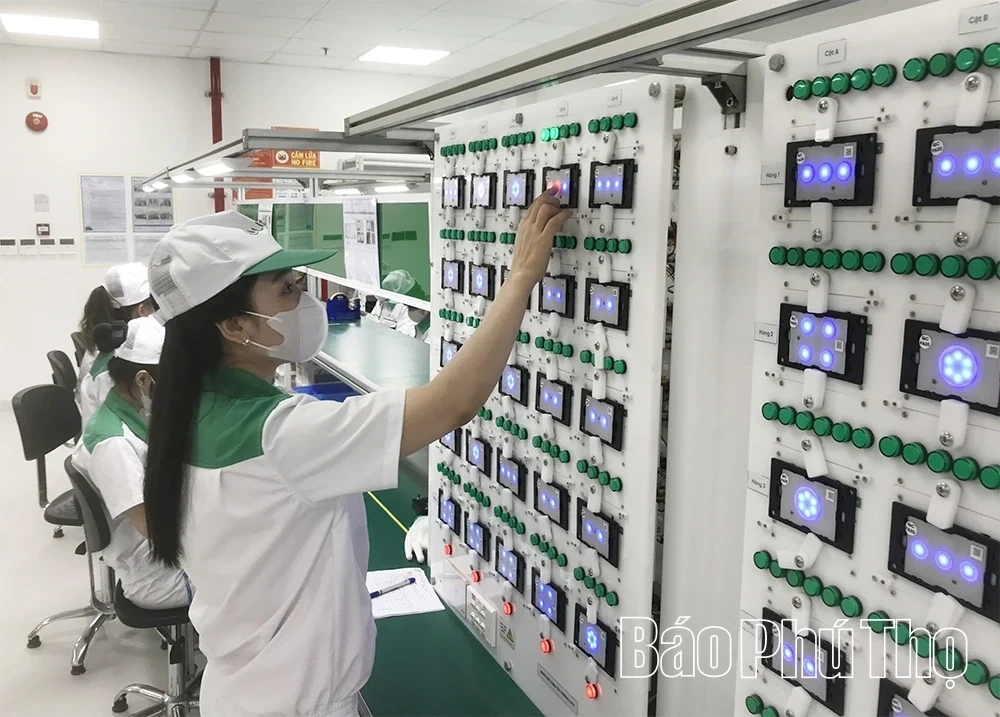
Thanks to prioritizing investment in modern technology, Lumi Smart Factory (Binh Xuyen Industrial Park) is Vietnam’s leading electronic device manufacturing plant built to international standards.
In the first six months of 2026, despite the global economic context continuing to evolve complexly, the province maintained positive development momentum across various fields. What is notable lies not only in growth targets, but also in the clear shift in development mindsets. Major central guidelines on developing science and technology, innovation, digital transformation, and private economic development have been concretized through action programs, projects, and implementation plans—aiming to build an economy relying more heavily on knowledge, technology, and labor productivity.
For many years, Phu Tho’s economic growth was primarily driven by investment expansion and tapping advantages in geographical location, land funds, labor force, and processing-manufacturing industry development. These factors continue to demonstrate efficiency; however, if relying solely on increasing investment capital or expanding production scale, room for growth will grow increasingly narrow. Domestic and international development practices show that whichever locality masters science and technology, innovation, and high-quality human resources will generate a sustainable competitive advantage.
That is also why Phu Tho determines innovating its growth model as a consistent requirement throughout the new development period. Not merely aiming to expand economic scale, the province places its focus on elevating growth quality, raising total factor productivity, and developing high-tech industries, modern services, the digital economy, the green economy, and enterprise innovation. These directions have been concretized in the Two-Digit Economic Growth Project for the 2026–2030 Period and action programs implementing Resolution No. 57-NQ/TW of the Politburo.
Delivering directing remarks at provincial socio-economic management conferences—especially at the Provincial People’s Council session on June 30 and the meeting on July 1 regarding management mindset transformation—Chairman of the Provincial People’s Committee Tran Duy Dong required all levels and sectors to strongly innovate management mindsets toward result-based governance, taking practical efficiency and satisfaction of citizens and enterprises as the yardstick. Simultaneously, focus must be placed on removing institutional bottlenecks, improving the business investment environment, promoting digital transformation, and advancing science, technology, and innovation to create new growth drivers for the economy. That guiding spirit is being concretized through synchronized solutions ranging from administrative reform and digital infrastructure development to selective investment attraction—prioritizing high-tech and environmentally friendly projects.
The shift in the growth model is reflected most clearly in investment attraction work. While priorities previously focused mainly on increasing project quantities, the province now aims to select investors with strong financial capacity, modern technology, integration capabilities with domestic enterprises, and high added-value generation. This trend aligns with requirements to restructure the economy, raise labor productivity, and incrementally participate more deeply in global value chains.
In parallel, the private economic sector is identified as one of the crucial drivers of growth. The implementation of Resolution No. 68-NQ/TW of the Politburo has fostered added confidence for the business community, encouraging enterprises to invest in technological innovation, digital transformation, and governance capacity enhancement. When businesses develop through technology and creativity rather than merely expanding production scale, the growth quality of the economy is elevated accordingly.
Another key driver is science, technology, and innovation. Following one year of implementing Resolution No. 57-NQ/TW of the Politburo, many central tasks have been intensively executed by the province—ranging from developing digital infrastructure, databases, and digital government to supporting enterprises in applying new technologies in production and business. This serves not only as a solution to elevate state management efficiency, but also lays the foundation for digital economy growth in coming years. According to Director of the Department of Science and Technology Nguyen Minh Tuong, science, technology, and innovation are no longer supporting sectors, but are becoming direct drivers of growth. The province’s focus is building an innovation ecosystem, supporting enterprises to research and apply new technology, driving comprehensive digital transformation, and developing high-quality human resources. When enterprises innovate technology, raise productivity, and generate products rich in intellectual content, the economy will grow in depth rather than depending on expanding input factors.
Innovating the growth model also means elevating state governance quality. Reforming administrative procedures, building digital government, strengthening decentralization and delegation of authority, raising leader accountability, and accompanying enterprises are contributing to reducing social costs and raising local competitiveness. Amidst fierce investment attraction competition among provinces and cities, management quality will become a competitive advantage no less vital than infrastructure or geographical location.
The new development space following consolidation opens up numerous opportunities for Phu Tho to make a breakthrough. However, scale advantages will truly take effect only when converted into new competitive capabilities based on knowledge, technology, innovation, and human resource quality. That is also the shortest path to realizing fast and sustainable growth objectives, improving citizens' living standards, and building Phu Tho into an important growth pole of the Northern Midland and Mountainous region in the new development phase.
Quang Nam

baophutho.vn In the digital era and international integration, the competitive advantage of each locality is no longer determined primarily by natural...

baophutho.vn On the afternoon of August 7, Mr. Bui Hong Do, Director of the Phu Tho Provincial Investment Promotion and Business Support Center, received...

baophutho.vn Implementing the directives of the Party and State on reorganizing agricultural production, many localities are connecting smallholder...

baophutho.vn Amid global economic uncertainties caused by geopolitical conflicts and volatile fuel prices, Phu Tho Province has maintained strong growth...

baophutho.vn On August 4, in Tan Lac Commune, the Vietnam Organic Agriculture Association coordinated with the Provincial Farmers' Union to organize a...

baophutho.vn Implementing the target of double-digit economic growth, Phu Tho is focusing on developing its system of industrial parks (IPs) and industrial...

baophutho.vn Following the provincial merger, Phu Tho has entered a new stage of development with a broader economic space, more concentrated resources, and...

baophutho.vn The province currently has 2,130 cooperatives, of which 1,797 are in operation, accounting for 84.36% of the total. Phu Tho is also home to...

baophutho.vn On July 29, Tran Duy Dong, Alternate Member of the Party Central Committee, Deputy Secretary of the Provincial Party Committee and Chairman of...

baophutho.vn No longer merely a supporting service for manufacturing, logistics has evolved into the economy's "soft infrastructure," determining the speed...
Editor-in-chief: Vi Manh Hung
License No.154/GP-BTTTT dated March 3,2022 by the Ministry of Information and Communications.
Address : No.Nguyen Tat Thanh street, Viet Tri ward, Phu Tho province
Tel: (0210) 3846.508; (0210) 3855.303
Email: info@baophutho.vn
Website: baophutho.vn
Copyrights Phu Tho Newspaper; All rights reserved
