
{title}
{publish}
{head}

Following the provincial merger, Phu Tho has entered a new stage of development with a broader economic space, more concentrated resources, and stronger synergies among its distinctive production regions. In this context, the One Commune One Product (OCOP) Program continues to play a pivotal role in restructuring the rural economy, increasing the value of agricultural products, strengthening the collective economy, and supporting new-style rural development.
In line with the province’s direction, the Sub-department of Rural Development under the Department of Agriculture and Environment, the standing agency of the Provincial OCOP Council, has focused on assisting OCOP producers in standardizing products in accordance with the national OCOP criteria. Support has included improving production processes, ensuring product quality, food safety, traceability, and brand development.
At the same time, the province has strengthened post-certification inspection and quality monitoring to safeguard the reputation of Phu Tho’s OCOP brand.
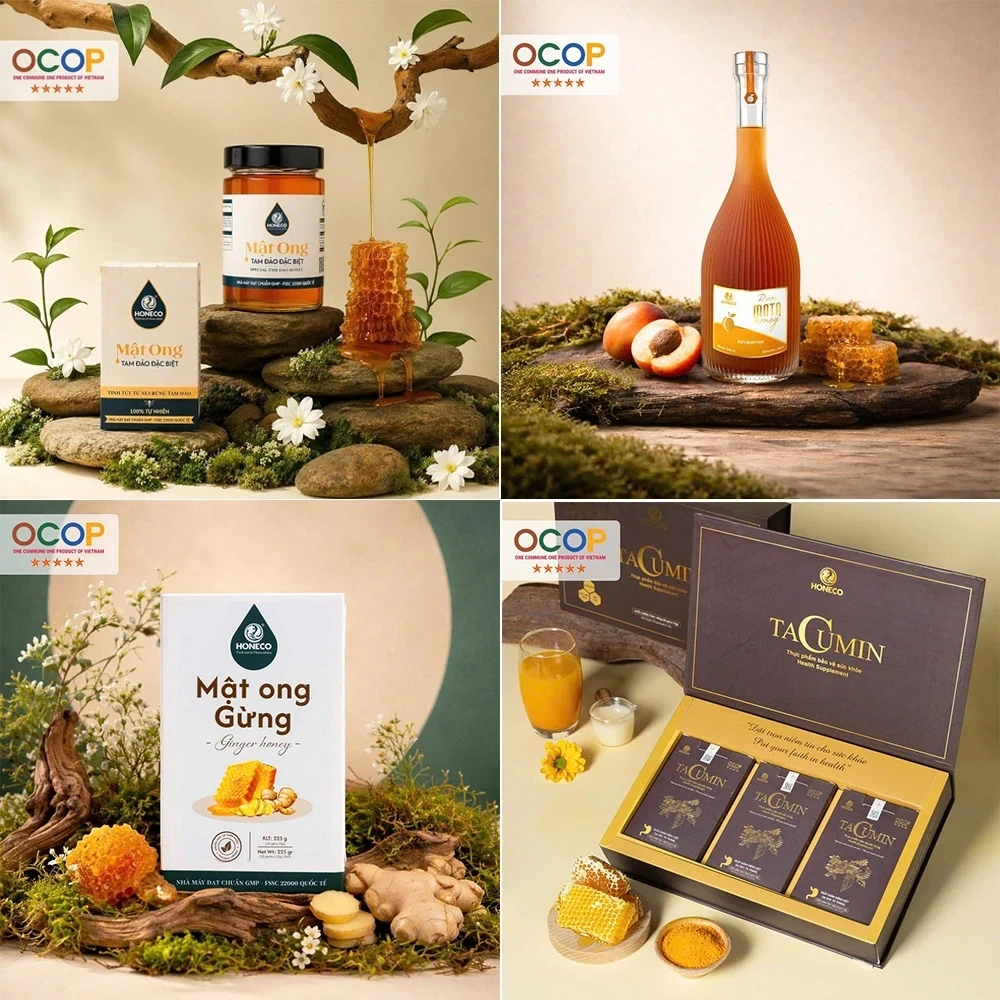
National five-star OCOP products of Tam Dao Honey Joint Stock Company in Xuan Lang Commune.
Alongside product standardization, Phu Tho has prioritized the development of the collective economy by building standardized raw material areas, promoting the application of science and technology, investing in processing industries, and establishing sustainable value chains.
The province has also supported OCOP producers in participating in trade fairs, agricultural promotion events, OCOP product exhibition centers, and supply-demand connection programs with other localities, enabling certified products to expand into modern distribution systems.
Originally launched as a rural economic development initiative, the OCOP Program is gradually evolving toward a model based on green and circular economy principles, bringing significant changes to production practices.
Cooperatives, enterprises, and household producers have proactively invested in processing technologies, improved packaging and branding, adopted product traceability systems and quality standards, and applied digital technologies in product promotion and marketing.
Many products, including tea, fermented pork (thit chua), honey, specialty rice, medicinal herbs, and traditional handicrafts, have continued to strengthen their market position.
After many years of implementation, the OCOP Program has become an important driver of rural economic development. Hundreds of local specialty products have been standardized, maximizing the comparative advantages of individual localities. Numerous production models featuring high technology, digitalized production processes, traceability systems, and e-commerce have been successfully established and replicated.
Beyond generating economic value, the program has also contributed to preserving traditional crafts, promoting indigenous knowledge, linking local products with community-based tourism, creating additional livelihoods for rural residents, and supporting new-style rural development and sustainable poverty reduction.
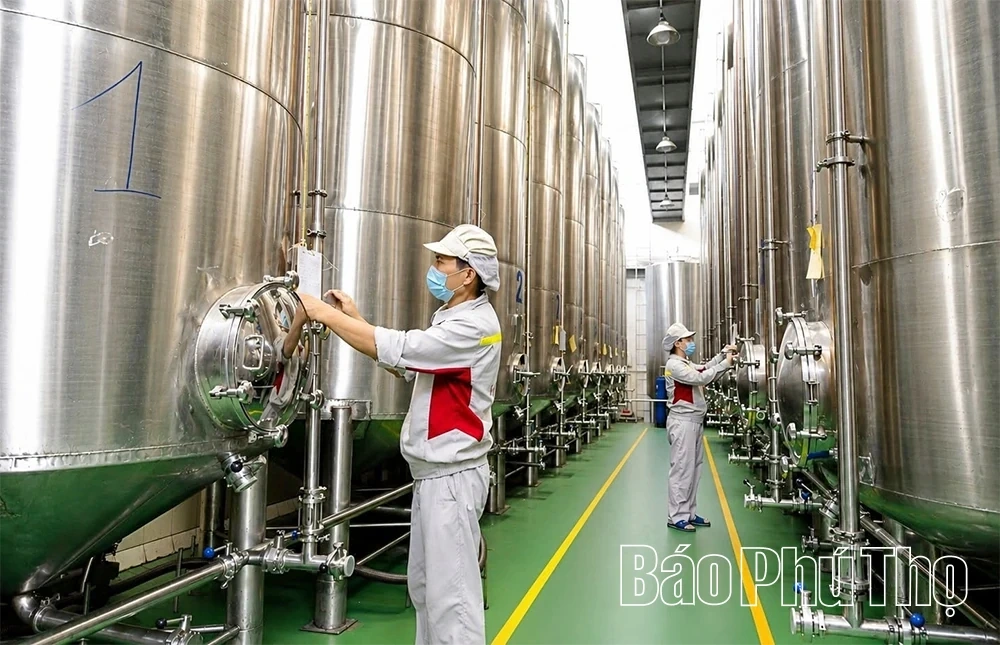
Specialized stainless-steel storage tanks for honey at Tam Dao Honey Joint Stock Company in Xuan Lang Commune.
According to Nguyen Van Quan, Deputy Director of the Department of Agriculture and Environment, OCOP certification is more than a product label—it is a recognition of quality, value, identity, and the reputation of Phu Tho’s products.
Each OCOP product reflects a combination of natural resources, indigenous knowledge, and innovation, helping traditional products reach broader markets.
He emphasized that producers should strictly comply with regulations on quality, food safety and product traceability, while continuing to innovate technologies, improve product design, strengthen value-chain linkages, and upgrade product ratings.
As of June 2026, Phu Tho had 592 valid OCOP products rated three stars or higher, including 496 three-star products, 87 four-star products, and nine national five-star products, produced by 356 OCOP entities, comprising 13 cooperative groups, 151 cooperatives, 59 enterprises, and 133 household businesses and production establishments.
After certification, these products are authorized to use the official OCOP logo and trademark, enhancing their brand value and competitiveness in modern retail distribution systems.
According to the provincial plan, by the end of 2026, Phu Tho aims to develop more than 50 additional OCOP products rated three stars or above, while further strengthening post-certification quality inspection and supervision to ensure that the OCOP label remains a trusted guarantee of quality for consumers.
As agricultural restructuring and new-style rural development enter a more advanced stage, the OCOP Program continues to demonstrate its effectiveness by shifting production from traditional methods toward value-added, quality-oriented development centered on branding and competitiveness.
With the concerted efforts of government agencies, enterprises, cooperatives and local communities, the OCOP Program will continue to serve as a key driver of sustainable rural economic development, improving rural incomes while strengthening the reputation of Phu Tho’s agricultural products.
Ngoc Lam

baophutho.vn The growth figures in industry, export, and investment attraction during the early months of 2026 are unlocking new development spaces for Phu...

baophutho.vn Throughout the development journey of the Land of the Hung Kings, cooperatives have increasingly affirmed their role as one of the important...

baophutho.vn On the afternoon of August 21, the Department of Industry and Trade held a working session with representatives from Samsung Vietnam.

baophutho.vn Tapping into existing inherent advantages, Minh Dai Commune is step-by-step elevating the value of its agricultural produce through a new...

baophutho.vn With Phu Tho’s GRDP growing by 10.18% in the first six months of 2026, the province has established an important foundation for achieving its...

baophutho.vn Such was the directive issued by Comrade Tran Duy Dong — Alternate Member of the Party Central Committee, Deputy Secretary of the Provincial...

baophutho.vn On the morning of August 18, in Xuan Lang Commune, Nam Binh Xuyen Green Park Development Co., Ltd., in coordination with CNCTech Group, held a...

baophutho.vn Phu Tho is focusing on implementing Resolution No. 41/2025/NQ-HDND, dated November 25, 2025, issued by the Provincial People’s Council on...

baophutho.vn On August 14, Provincial Party Committee Member and Vice Chairwoman of the Provincial People’s Committee Phung Thi Kim Nga chaired a thematic...

baophutho.vn Public investment is identified as a vital driving force behind economic growth. Therefore, right from the beginning of 2026, Tan Son Commune...
Editor-in-chief: Vi Manh Hung
License No.154/GP-BTTTT dated March 3,2022 by the Ministry of Information and Communications.
Address : No.Nguyen Tat Thanh street, Viet Tri ward, Phu Tho province
Tel: (0210) 3846.508; (0210) 3855.303
Email: info@baophutho.vn
Website: baophutho.vn
Copyrights Phu Tho Newspaper; All rights reserved
